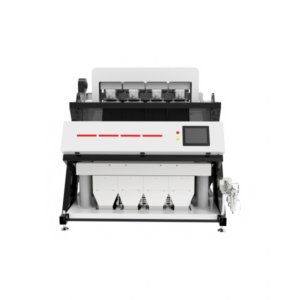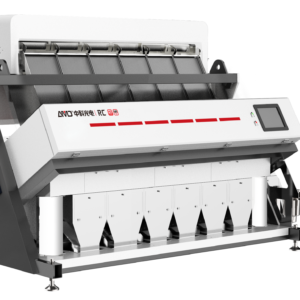
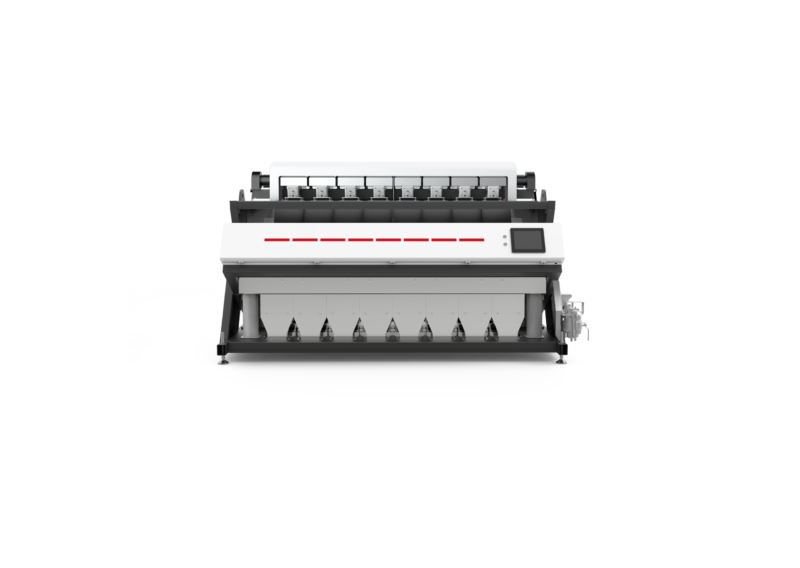
| Product Name | RC-E Grain Color Sorter Machine |
| Model | RC8-E |
| Capacity | 4.5-8 t/h |
| Accuracy | ≥99.9% |
| Voltage | 220V / 50Hz |
| Power | 5.9 kW |
| Weight | 1800 kg |
| Dimension | 3293 × 1829× 1887 mm |
The RC8-E Grain Color Sorter Machine is a high-capacity optical sorting solution developed for commercial grain processors that require reliable quality control across multiple agricultural products. With an 8-chute configuration and a processing capacity of 4.5–8 T/H, the RC8-E provides the throughput required for commercial and high-throughput grain cleaning, processing, and packaging lines.
Rather than limiting production to a single crop, the RC8-E supports a broad range of materials, including wheat, corn, beans, lentils, chickpeas, peanuts, and various seeds. Its optical recognition system analyzes the material stream and identifies unwanted grains or impurities according to visible differences in color, shape, and surface appearance.
For facilities handling different raw materials, seasonal crops, or multiple quality grades, the RC8-E provides a flexible way to automate quality control, maintain more consistent finished-product quality, and reduce dependence on manual inspection.
Incoming agricultural materials rarely arrive with completely uniform quality. Discolored kernels, damaged grains, abnormal materials, and foreign impurities can reduce the value of the finished product and create additional challenges during downstream processing.
The RC8-E automates quality control at this critical stage.
As material passes through the sorting channels, the optical system continuously inspects the product stream. Intelligent sorting algorithms analyze visible characteristics and compare individual particles with the configured sorting criteria. When the system identifies unwanted material, the ejection system removes it from the accepted product stream.
The RC8-E can help identify and separate:
Operators can configure sorting parameters according to the characteristics of each raw material and the required finished-product standard. This flexibility makes the RC8-E particularly useful for processors that handle seasonal crop changes or several agricultural products on the same production line.
Effective grain sorting requires more than simply separating light materials from dark ones. Natural variations within agricultural products can make classification more challenging, especially when acceptable and defective grains have similar appearances.
The RC8-E uses intelligent recognition algorithms to analyze visible differences in the material stream. The sorting system evaluates characteristics such as color, shape, and surface appearance, allowing processors to establish sorting criteria that match different raw materials and quality requirements.
This approach provides greater flexibility when handling products with different visual characteristics.
When production changes from wheat to beans, pulses, seeds, or another compatible material, operators can configure the sorting parameters around the new product rather than relying on a dedicated machine for every crop.
For multi-product grain processing facilities, this flexibility can improve equipment utilization and simplify production planning throughout the year.
Accurate recognition represents only one part of effective optical sorting. Material must also move through the sorting area in a stable and controlled manner.
The RC8-E uses an intelligent feeding system to maintain consistent material distribution across its eight sorting channels. Stable feeding helps reduce excessive material overlap and creates better conditions for optical inspection.
Once the recognition system identifies unwanted material, the high-speed ejection system removes the selected particle from the product stream. Precise coordination between recognition and ejection helps maintain separation performance while reducing unnecessary removal of acceptable material.
This balance is especially important in commercial grain processing. Removing too little defective material can affect finished-product quality, while sending too much acceptable grain into the reject stream reduces usable yield.
With a processing capacity of 4.5–8 T/H, the RC8-E provides a practical option for processors that need higher throughput from a multi-purpose grain sorting platform.
Actual processing capacity can vary according to the raw material, incoming impurity level, sorting difficulty, feed conditions, and required finished-product quality.
The multi-material capability of the RC8-E allows processors to use one sorting platform for different agricultural commodities.
Typical applications include:
This versatility makes the RC8-E suitable for facilities that process a single commodity at higher volumes as well as businesses that switch between different agricultural products throughout the year.
Selecting the right grain color sorter involves more than comparing maximum throughput. Processors also need to consider material diversity, incoming defect levels, sorting difficulty, finished-product requirements, and acceptable-product recovery.
The RC8-E combines several practical features for commercial grain processing:
The eight sorting channels provide the material-handling capability required for higher-throughput production. With a processing capacity of 4.5–8 T/H, the RC8-E suits medium- to large-scale grain processing operations.
The RC8-E can process different grains, beans, pulses, peanuts, seeds, and similar agricultural materials. This flexibility helps facilities adapt to seasonal production changes without dedicating separate sorting equipment to every product.
Processors can configure sorting parameters according to raw-material characteristics and finished-product requirements, providing greater flexibility when handling different commodities or quality grades.
Accurate recognition and targeted ejection help reduce the amount of acceptable material entering the reject stream. Lower good-product carry-out can improve usable yield and become particularly valuable when processing large volumes or higher-value agricultural products.
The modular hardware platform supports practical operation and maintenance while providing a flexible foundation for commercial grain sorting applications.
An expandable and compatible design gives processors greater flexibility as sorting requirements and production needs develop.
The RC8-E is designed for businesses that need continuous automated sorting and greater capacity than smaller multi-purpose grain sorters.
Typical users include:
Rated throughput alone should not determine machine selection. Material type, incoming defect ratio, sorting difficulty, required finished-product quality, and acceptable-product recovery should also be evaluated.
For example, a processing line handling relatively clean wheat may achieve a different practical throughput from a line processing beans with a higher percentage of defective or unwanted material.
PolySorter can evaluate your raw material, target defects, expected throughput, and finished-product requirements to help determine whether the RC8-E matches your processing needs.
The RC8-E supports multiple agricultural products, including wheat, corn, beans, lentils, chickpeas, peanuts, seeds, and other compatible granular materials. Sorting settings can be configured according to the characteristics of different products.
The RC8-E provides a processing capacity of approximately 4.5–8 T/H. Actual throughput depends on factors such as material type, impurity level, sorting difficulty, feed conditions, and required finished-product quality.
Yes. The RC8-E is designed as a multi-purpose sorting platform. Processors handling different crops can configure sorting parameters according to the visual characteristics and quality requirements of each material.
Consider your raw material, required hourly capacity, incoming defect percentage, defects or impurities that need to be removed, required finished-product quality, and acceptable product recovery. These factors provide a more reliable basis for machine selection than throughput alone.
Consistent grain quality can directly influence product value, downstream processing efficiency, customer acceptance, and the competitiveness of the finished product. As processing volumes increase, manual inspection becomes increasingly difficult to maintain at a consistent level.
The RC8-E Grain Color Sorter Machine provides an automated, high-capacity solution for this quality-control stage. Its combination of an 8-chute configuration, intelligent optical recognition, stable material feeding, precise ejection, and multi-product compatibility makes it a practical choice for modern grain processing facilities.
Whether you process wheat, corn, beans, pulses, peanuts, seeds, or several agricultural products throughout the year, the RC8-E can be configured around your specific sorting requirements.
Contact PolySorter today with your raw material, target defects, expected processing capacity, and finished-product requirements. Our team can help you evaluate the appropriate RC8-E configuration for your processing line.