| Parameter | Specification |
| Model | RG8-E |
| Machine Type | Rice Color Sorter Machine |
| Sorting Technology | Optical / Visible-Light Sorting |
| Throughput | 8.5–10 t/h |
| Sorting Accuracy | >99.99% |
| Voltage / Frequency | 220 V / 50 Hz |
| Power | 5.9 kW |
| Weight | 1800 kg |
| Dimensions (L × W × H) | 3293 × 1610 × 1887 mm |
| Typical Sorting Applications | Yellow Rice, Dark Yellow Rice, Chalky Rice, Discolored Rice, Broken Rice |
| Application | Commercial Rice Processing and Quality Sorting |
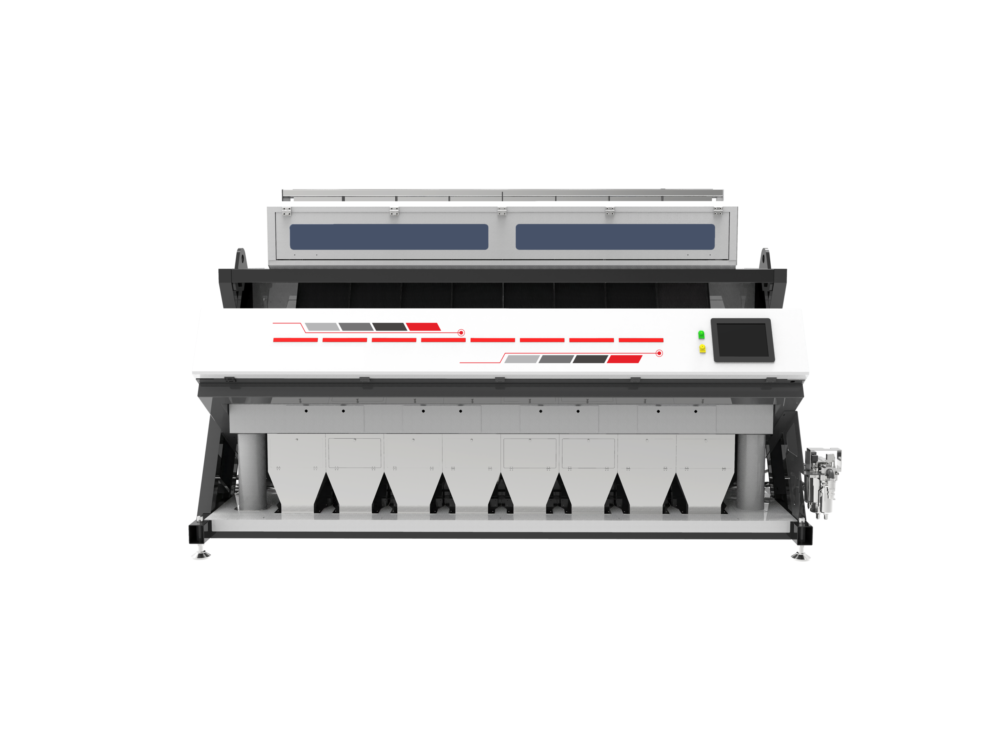
The RG8-E Rice Color Sorter Machine is designed for commercial rice mills and processing plants that require reliable optical sorting at higher production volumes. With a rated throughput of 8.5–10 tons per hour, it combines intelligent image recognition, precise optical inspection, stable material feeding, and targeted rejection to improve finished-rice consistency.
Rice quality can vary significantly between batches. Yellow grains, dark yellow grains, chalky kernels, discolored rice, broken grains, and other visible irregularities can affect the appearance and commercial quality of the final product. The RG8-E continuously inspects the material stream and separates selected materials according to the processor’s quality requirements.
Its optical sorting system analyzes visible characteristics as rice passes through the inspection zone. Once the system identifies a grain that matches the configured rejection criteria, the rejection mechanism responds rapidly to separate it from the accepted product stream.
With sorting accuracy above 99.99% under suitable operating conditions, the RG8-E provides a practical combination of sorting precision, processing capacity, and operational efficiency for modern rice production lines.
Increasing production capacity creates additional challenges for quality control. Manual inspection becomes less practical as processing volumes rise, while an undersized sorting machine can restrict the efficiency of the entire production line.
The RG8-E addresses this challenge with a rated processing capacity of 8.5–10 t/h, making it suitable for medium- and large-scale commercial rice processing operations.
Stable material feeding plays an important role at these production levels. The feeding system distributes rice across the sorting channels before it reaches the optical inspection area. More uniform material distribution helps reduce excessive overlapping and creates better conditions for image capture, material recognition, and precise rejection.
The RG8-E can support a variety of commercial processing environments, including:
For processors expanding production or upgrading an existing facility, the RG8-E can operate as a dedicated optical quality-control stage within the rice processing line.
Different rice processors face different quality challenges. One facility may need to reduce yellow kernels, while another may focus on chalkiness, discoloration, broken grains, or overall visual consistency.
The RG8-E Rice Color Sorter Machine supports different sorting tasks based on visible differences between acceptable rice and material that falls outside the configured quality criteria.
Yellow and dark yellow kernels can reduce the visual uniformity of finished rice. The optical recognition system detects visible color differences between acceptable rice and selected yellow or darkened grains, allowing the rejection system to separate them according to the required quality standard.
Chalkiness creates visibly opaque or chalk-like areas within rice kernels. Depending on the required finished-product specification, the RG8-E can identify these visible differences and separate selected chalky grains from the product stream.
The sorting configuration can also be adapted to different production objectives. For example, processors may configure the system to reject chalky grains while retaining rice that meets another selected appearance standard.
Rice batches may contain grains with visible discoloration that differs from the desired finished product. Optical inspection helps identify these color variations so that selected grains can be separated according to configured recognition criteria.
Not every sorting task involves removing a defective grain. Some rice processing operations require additional separation according to visible differences in grain appearance, color, or integrity.
The RG8-E can support sorting tasks involving broken grains and other visually distinguishable material according to the configured sorting criteria and required finished-product standard.
Incoming rice rarely contains only one type of visible variation. The RG8-E can support sorting tasks involving multiple characteristics, including combinations of yellow and chalky grains.
This flexibility allows processors to adapt the sorting process when rice varieties, incoming material conditions, or finished-product requirements change.
Reliable rice sorting requires material feeding, image acquisition, recognition, positioning, and rejection to work together at production speed. The RG8-E integrates these functions into a continuous optical sorting process for commercial rice processing.
The recognition system evaluates multiple visible characteristics of rice moving through the inspection area. Image processing can analyze features such as color, shape, texture, and area, providing more detailed information for material classification.
This multi-feature approach helps the sorting system distinguish between grains according to the quality criteria selected by the processor.
Accurate sorting begins with reliable image acquisition. The optical system captures subtle visible differences between individual grains as they move through the inspection zone.
High-transmittance optical components help reproduce colors and visible characteristics accurately, providing clearer image information for recognition and sorting decisions.
At commercial processing speeds, the system must process large amounts of image information continuously.
The intelligent sorting system analyzes captured images in real time and applies the selected recognition criteria. Operators can adjust sorting parameters according to incoming rice conditions and required finished-product quality rather than relying on one fixed sorting setting.
Recognizing a selected grain is only part of the sorting process. The machine must also determine its position and activate the rejection system at the correct moment.
The positioning system evaluates information associated with material trajectory, spatial position, and movement. This coordination between recognition and rejection helps separate selected material while reducing unnecessary rejection of acceptable rice.
Consistent material distribution creates better conditions for optical inspection.
The feeding system controls material flow before rice enters the sorting zone, helping reduce irregular concentrations and excessive overlapping. This allows the vision system to inspect material more consistently while maintaining higher processing capacity.
Selecting a rice color sorter involves more than comparing a single accuracy or capacity figure. The machine should match actual production volume, incoming material conditions, sorting objectives, and finished-product requirements.
The RG8-E combines several practical advantages for commercial rice processing.
With a rated throughput of 8.5–10 tons per hour, the RG8-E supports higher-volume processing facilities where smaller sorting equipment may create a production bottleneck.
This capacity makes it suitable for processors upgrading an existing line or planning a commercial rice processing system with higher output requirements.
Optical imaging, intelligent recognition, controlled feeding, and targeted rejection work together to deliver sorting accuracy above 99.99% under suitable operating conditions.
Actual sorting performance can vary according to rice variety, incoming material quality, defect concentration, feeding conditions, and required sorting standards.
Incoming rice conditions can change between varieties, suppliers, growing regions, and production batches.
Operators can configure sorting criteria according to different visible characteristics and finished-product requirements, allowing the machine to adapt to changing production needs.
Effective sorting should separate unwanted material without unnecessarily removing acceptable rice.
Accurate recognition and targeted rejection help limit good-product carryover, supporting finished-rice quality while protecting usable product recovery.
Commercial rice mills often require sorting equipment to operate continuously for extended production periods.
Controlled feeding and high-speed optical recognition help the RG8-E maintain stable sorting conditions as material moves through the machine, making it suitable for integration into continuous processing lines.
The modular machine structure provides practical access to key sections during routine inspection, cleaning, and maintenance, helping simplify regular equipment servicing.
The RG8-E can serve as a dedicated quality-control stage within a complete rice processing line. Processors can integrate the machine after major cleaning and milling stages to separate remaining visually distinguishable material before final grading or packaging.
Typical sorting applications include:
The appropriate sorting strategy depends on the required final product.
A premium packaged-rice producer may prioritize visual uniformity and stricter separation of yellow, discolored, or chalky grains. A high-volume commercial processor may place greater emphasis on maintaining production capacity while reaching a defined finished-rice quality standard.
The system can also accommodate different sorting objectives according to the characteristics of the incoming material. This allows the RG8-E to support multiple rice processing requirements rather than limiting the machine to one fixed defect category.
The RG8-E is designed for integration into commercial rice milling and processing lines as a dedicated optical quality-control stage.
Stable upstream feeding and appropriate downstream capacity help the sorting machine operate efficiently within the complete production process. The condition of the material entering the sorter also influences achievable throughput and sorting results.
When selecting and configuring the RG8-E, processors should evaluate:
Matching these conditions with the appropriate sorting configuration helps achieve a better balance between throughput, separation performance, and good-product recovery.
The RG8-E has a rated throughput of 8.5–10 tons per hour. Actual processing capacity can vary depending on rice variety, incoming material condition, defect concentration, feeding rate, and required sorting standard.
The RG8-E is designed for rice sorting applications where materials can be distinguished by visible characteristics. Typical sorting tasks include separating yellow, dark yellow, chalky, discolored, and broken grains according to the required finished-product standard.
Yes. The system supports sorting tasks involving multiple visible characteristics, including combinations of yellow and chalky rice, according to configured recognition criteria and actual material conditions.
Normal white rice is not automatically treated as a defect. The machine separates material according to the sorting criteria configured for a specific production task. Accept and reject decisions depend on the processor’s target product and selected sorting settings.
The RG8-E can support sorting tasks involving broken grains when they can be distinguished according to the configured visible characteristics and sorting requirements.
Yes. Its 8.5–10 t/h rated processing capacity makes it suitable for commercial and higher-capacity rice processing lines where smaller color sorters may restrict overall production throughput.
Throughput and sorting performance depend on incoming material conditions, defect concentration, feeding stability, and required output quality.
The RG8-E combines controlled feeding, optical recognition, and targeted rejection to support high-capacity sorting. Operators should configure the machine according to the actual material and required final quality rather than simply maximizing the feeding rate.
Yes. Different batches may present different visible characteristics and quality requirements. Operators can adjust sorting parameters according to incoming material conditions and the desired sorting result.
Consider your required hourly capacity together with rice variety, incoming material condition, main sorting targets, required finished-product quality, number of sorting passes, and the capacity of surrounding equipment.
For projects with specific sorting requirements, sample evaluation can help determine an appropriate machine configuration.
The RG8-E Rice Color Sorter Machine provides commercial rice processors with a high-capacity optical sorting solution for improving finished-product consistency and separating selected visible variations.
With a rated 8.5–10 t/h processing capacity, intelligent image recognition, balanced material feeding, and targeted rejection, the RG8-E is designed to balance sorting precision with the production demands of modern rice mills.
The right sorting configuration depends on the actual material and production objective. Rice variety, visible differences, incoming material condition, target capacity, and required finished-product quality can all influence the recommended setup.
Looking for a rice sorting solution for your processing line?
Send PolySorter your rice type, sample photos, main sorting targets, target processing capacity, and required finished-product quality. Our team can evaluate your application and recommend a suitable sorting configuration.
Contact PolySorter today to discuss your rice sorting project and request a quotation.