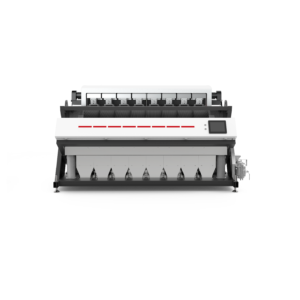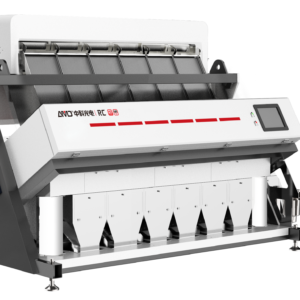
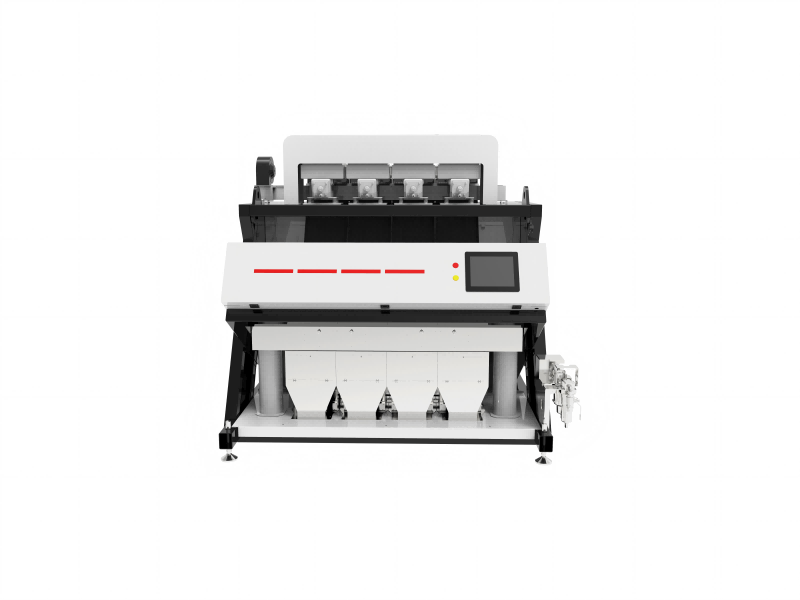
| Product Name | RC-E Grain Color Sorter Machine |
| Model | RC4-E |
| Capacity | 2.5-4 t/h |
| Accuracy | ≥99.9% |
| Voltage | 220V / 50Hz |
| Power | 2.9 kW |
| Weight | 1120 kg |
| Dimension | 2033 × 1610× 1887 mm |
The RC4-E Grain Color Sorter Machine is a multi-purpose optical sorting solution designed for agricultural processors that need reliable quality control at a practical, medium-scale production capacity.
Featuring a 4-chute configuration with a typical processing capacity of 2.5–4.0 tons per hour, the RC4-E provides a balanced combination of sorting performance, throughput, and equipment footprint. It is well suited to facilities upgrading from manual grading or basic mechanical cleaning to automated optical inspection.
The machine can process wheat, corn, beans, pulses, seeds, and other agricultural materials. By analyzing visible differences in the product stream, the RC4-E helps separate discolored kernels, visibly damaged grains, and selected foreign particles before the accepted material moves to downstream processing or packaging.
For grain processors handling different commodities throughout the year, this combination of capacity and flexibility makes the RC4-E a practical addition to both new and existing processing lines.
Agricultural processors rarely handle a single product throughout the entire year. Depending on harvest seasons, customer orders, regional supply, and market demand, the same facility may need to process several types of grains, pulses, or seeds.
The RC4-E is designed as a multi-commodity grain sorting platform, allowing operators to adjust sorting parameters according to the visible characteristics of different incoming materials.
Typical applications include:
Instead of dedicating separate optical sorting equipment to every crop, processors can use the RC4-E for multiple compatible commodities and adjust the sorting configuration when production requirements change.
This flexibility is particularly useful for grain traders, agricultural cooperatives, seed processors, food ingredient suppliers, and facilities that regularly switch between different raw materials.
Mechanical cleaning equipment is effective at separating materials according to characteristics such as size, weight, or density. However, some quality defects are better distinguished through differences in surface color and visible appearance.
The RC4-E adds an optical inspection stage to address these differences.
Raw material enters the machine and travels through four sorting channels. The feeding system helps create a stable and evenly distributed material flow through the inspection zone, allowing the optical system to observe individual particles more consistently.
Stable feeding is important because excessive material overlap or irregular flow can affect optical inspection and subsequent ejection performance.
As the material passes through the inspection area, the optical vision system analyzes visible characteristics and compares them with the configured sorting criteria.
Depending on the material and selected settings, the system can identify visible differences such as:
The sorting criteria can be adjusted according to the raw material and required finished-product standard rather than relying on a single fixed sorting rule.
When the system identifies a target particle, the corresponding high-speed ejector releases a short burst of compressed air to divert it from the accepted material stream.
Qualified material continues toward the accept outlet, while identified defects enter the reject stream.
The coordination between feeding, optical recognition, target positioning, and ejection allows the machine to perform continuous automated sorting at commercial processing speeds.
Successful grain sorting is not simply about rejecting as much material as possible.
For commercial processors, removing unwanted particles must be balanced against retaining acceptable product. An overly aggressive sorting configuration may increase reject volume unnecessarily, while settings that are too relaxed may allow more defective material into the accepted stream.
The RC4-E allows sorting parameters to be adjusted according to the required quality target.
This gives processors greater flexibility when working toward different production goals:
The appropriate settings depend on the actual raw material. For this reason, evaluating impurity characteristics and target quality is an important part of selecting and configuring any grain color sorter.
The RC4-E occupies a practical position between compact entry-level sorting equipment and larger high-throughput grain sorters.
With a reference processing capacity of 2.5–4.0 T/H, its four-chute configuration is particularly suitable for facilities that require dependable commercial throughput but do not need the capacity of a larger 6- or 8-chute system.
Typical applications include:
Actual throughput varies according to material type, particle size, incoming impurity percentage, feeding conditions, and the required sorting standard.
For processors comparing different machine sizes, the highest possible throughput should therefore not be the only selection criterion. Matching the sorter to the normal production volume helps avoid installing more sorting capacity than the processing line actually requires.
Optical sorting normally delivers the best results when it works as part of a complete grain cleaning and grading process.
Before reaching the RC4-E, incoming material may pass through pre-cleaners, screens, destoners, gravity separators, or other mechanical equipment. These processes can remove dust, oversized contaminants, undersized particles, stones, and other impurities that are more efficiently separated according to physical characteristics.
The optical grain sorter can then focus on defects that are distinguishable by visible appearance.
A typical processing sequence may look like this:
Raw Material → Pre-Cleaning → Sizing / Gravity Separation → RC4-E Color Sorting → Final Inspection → Packaging
The exact configuration depends on the crop, incoming material condition, target defects, and finished-product specification.
Because the RC4-E can operate as a dedicated optical quality-control stage, it can be incorporated into newly designed production lines or added when upgrading an existing grain cleaning facility.
Configure the machine for different grains, beans, pulses, and seeds, making it suitable for processors whose raw materials change throughout the production season.
The 2.5–4.0 T/H reference throughput provides a practical option for facilities that have outgrown smaller sorting equipment but do not require a large high-capacity machine.
The vision system analyzes visible differences within the material stream, helping separate unwanted particles according to configured quality criteria.
Different materials and product grades require different inspection standards. Sorting parameters can be adapted to suit the characteristics of the incoming product and the required finished quality.
High-speed air ejection removes identified defects while allowing acceptable material to continue through the qualified product stream.
The four-chute configuration can serve as an optical quality-control stage in both new grain processing installations and existing cleaning lines undergoing automation upgrades.
The RC4-E can be configured for a variety of agricultural materials, including wheat, corn, beans, chickpeas, lentils, peas, seeds, and other compatible granular products. The appropriate configuration depends on the material characteristics and the defects that need to be separated.
Depending on the material and sorting settings, the machine can identify discolored grains, visibly damaged kernels, abnormal-color particles, selected broken material, weed seeds, and foreign particles that show sufficient visible differences from acceptable products.
Optical sorting identifies visible characteristics. It should not be considered a direct test for chemical contaminants or defects that have no detectable optical expression.
The reference processing capacity is approximately 2.5–4.0 tons per hour. Actual throughput depends on the grain type, particle size, impurity level, feed condition, and required finished-product quality.
Yes. The RC4-E is designed as a multi-purpose grain sorting machine. Sorting parameters can be adjusted when switching between compatible grains, beans, pulses, and seeds.
No. Optical sorting and mechanical cleaning perform different functions.
Screens, destoners, gravity separators, and similar equipment are generally used to remove impurities according to physical properties such as size, weight, or density. The RC4-E focuses on defects that can be differentiated through visible appearance.
Using these technologies together usually provides a more complete grain cleaning process.
Yes. The machine can be integrated into an existing grain cleaning or grading line as an additional optical inspection stage. The appropriate installation position depends on upstream cleaning equipment, production capacity, material condition, and the desired final quality.
Start with your normal hourly production volume rather than selecting a machine based only on maximum capacity.
Material type, incoming defect percentage, target purity, and production schedule should all be considered. If your normal requirement falls within the RC4-E operating range, a four-chute configuration may provide a better capacity match than installing a substantially larger sorter.
Every grain processing project has different raw materials, defect profiles, throughput requirements, and finished-product standards. The best way to determine whether the RC4-E Grain Color Sorter Machine is suitable is to evaluate these factors together.
PolySorter can help you assess the required sorting configuration according to your material and production goals.
If you are unsure how your material will perform under optical sorting, send us a representative sample for evaluation.
Contact PolySorter to request a quote and sample sorting test for your grain, beans, pulses, or seeds.