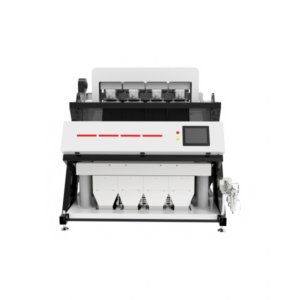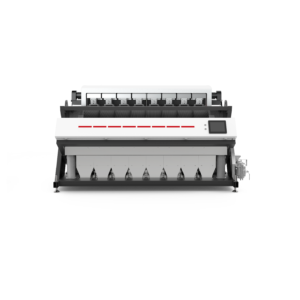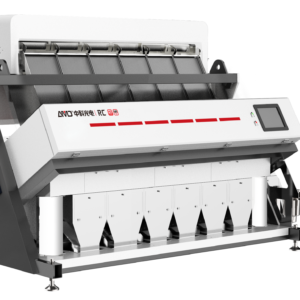
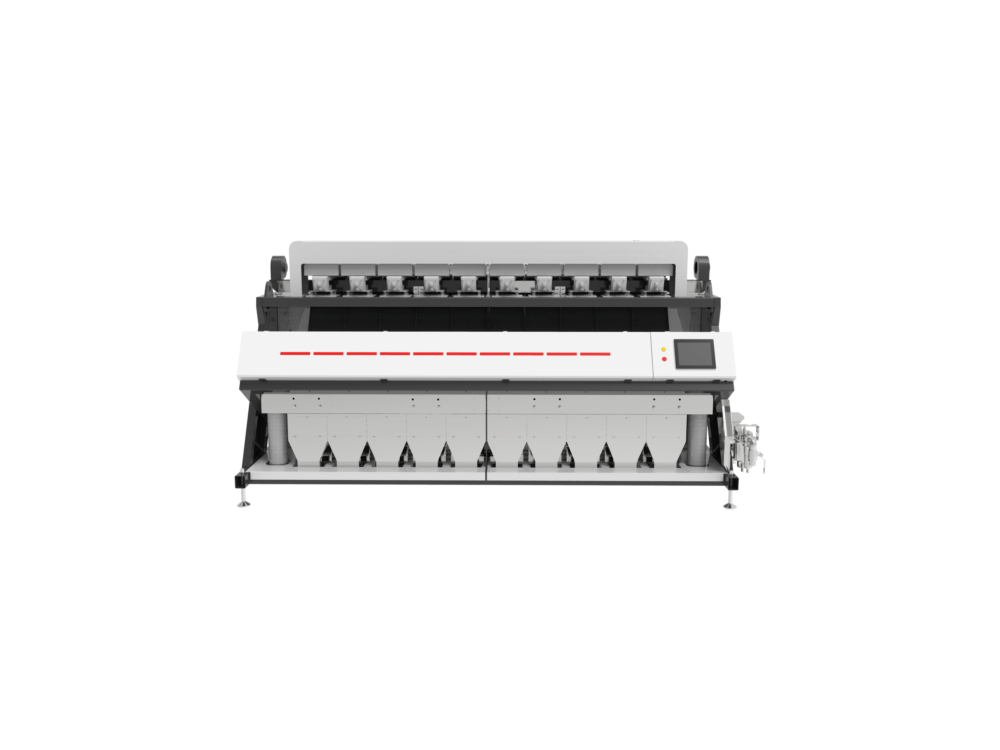
| Product Name | RC-E Grain Color Sorter Machine |
| Model | RC10-E |
| Capacity | 5-10 t/h |
| Accuracy | ≥99.9% |
| Voltage | 220V / 50Hz |
| Power | 7.3 kW |
| Weight | 2150 kg |
| Dimension | 3933*1829*1887 mm |
The RC10-E Grain Color Sorter Machine is a high-capacity optical sorting solution designed for large grain processors that require continuous throughput, multi-commodity flexibility, and consistent quality control across demanding production schedules.
Built around a 10-chute configuration, the RC10-E is positioned for large-scale grain cleaning, grading, seed processing, and food ingredient production lines where sorting capacity must keep pace with upstream and downstream equipment.
The machine can be configured for wheat, corn, beans, pulses, seeds, coffee beans, and other compatible agricultural materials. Its optical sorting system analyzes visible differences within the product stream and removes targeted discolored kernels, visibly damaged grains, and optically distinguishable foreign particles.
For processors operating at higher daily volumes, the RC10-E provides the sorting width and processing capability needed to automate quality control without creating an unnecessary bottleneck in the production line.
As grain processing capacity increases, the role of optical sorting changes.
In a smaller facility, a color sorter may process individual batches or selected premium products. In a large commercial plant, however, the sorting machine often becomes an integral part of a continuous production line. Its capacity must therefore be properly matched with upstream cleaning equipment, conveying systems, downstream inspection, and packaging operations.
The RC10-E is designed for this type of high-volume environment.
Its 10-chute architecture provides a wider sorting platform for processing large quantities of agricultural material while maintaining controlled presentation through the optical inspection zone.
Typical applications include:
Rather than selecting a larger machine simply because it offers more sorting channels, processors should consider whether the capacity of the RC10-E matches the actual flow rate of the complete production line.
High-capacity does not necessarily mean single-product processing.
Large agricultural facilities may handle different commodities according to harvest season, sourcing conditions, customer orders, and finished-product specifications. A sorting system therefore needs enough flexibility to adapt when the incoming material changes.
The RC10-E is part of a multi-functional optical sorting platform designed for different agricultural products.
Typical materials include:
The RC-E platform is designed around intelligent recognition, modular hardware, sorting performance, and compatibility across different sorting applications. This allows the sorting configuration to be adapted to the visible characteristics of different materials rather than limiting the machine to a single commodity.
For processors handling multiple product categories, this flexibility can make better use of installed sorting capacity throughout the year.
The RC10-E combines controlled feeding, optical recognition, intelligent analysis, and targeted ejection into a continuous sorting process.
Incoming material is distributed across the machine’s sorting channels and guided through the inspection area.
At high processing volumes, stable feeding becomes particularly important. Irregular flow or excessive material overlap can reduce the amount of useful visual information available to the optical system.
The feeding and chute arrangement therefore helps maintain a controlled and evenly distributed material stream as grain enters the inspection zone.
As individual particles pass through the viewing area, the optical system analyzes their visible characteristics according to the configured sorting criteria.
Depending on the material and application, the RC10-E can be configured to identify visible differences such as:
The system evaluates these differences continuously while material moves through the sorter.
This is particularly useful for agricultural products because natural variation between batches means that one fixed sorting criterion may not be appropriate for every incoming load.
Once an unwanted particle is identified and its position is determined, the corresponding ejector uses compressed air to divert it from the accepted material stream.
Qualified material continues toward the accept outlet while the targeted particle enters the reject stream.
Accurate coordination between material feeding, optical recognition, target positioning, and air ejection is essential for maintaining effective separation during continuous high-volume processing.
Increasing throughput is useful only when the required finished-product quality can still be maintained.
For this reason, evaluating a high-capacity grain sorting machine should involve more than comparing tons-per-hour figures.
The RC10-E allows sorting criteria to be configured according to the material and required finished-product standard. This helps processors work toward an appropriate balance between impurity removal and usable product recovery.
Stricter sorting criteria can be applied when processing material intended for higher quality grades, premium packaging, or other applications with demanding visual specifications.
Rejecting acceptable grain together with defective material reduces sellable yield. Sorting settings should therefore be adjusted to remove targeted defects without creating unnecessary product loss.
Agricultural raw materials naturally change according to harvest, supplier, growing region, storage conditions, and initial cleaning quality.
Adjustable sorting criteria allow the processing line to respond to these variations rather than relying on identical settings for every batch.
For a large processing plant, even relatively small differences in recovery can become significant when multiplied across high daily production volumes. Sorting performance should therefore be evaluated in terms of both finished quality and usable yield.
The main reason to select a 10-chute grain sorter is not simply to own a larger machine. It is to provide sufficient optical sorting capacity for a production line that genuinely requires it.
The RC10-E is best suited to facilities where incoming material volumes could exceed the practical capacity of smaller sorting configurations.
This makes it particularly relevant when:
However, machine selection should always be based on actual production requirements.
Material type, particle size, incoming defect percentage, target purity, number of sorting passes, and upstream feed conditions can all influence practical throughput.
For a medium-volume operation, a smaller RC-E configuration may provide a better capacity match. For a genuinely high-volume facility, the RC10-E provides additional sorting capacity that can better align with the rest of the processing line.
A grain color sorter should not be expected to replace every other cleaning process.
Mechanical and optical sorting technologies address different characteristics. Screens, destoners, gravity separators, aspiration systems, and related equipment can remove contaminants according to properties such as size, density, or aerodynamic behavior.
The RC10-E can then focus on particles that can be distinguished according to visible optical characteristics.
A typical process may follow this sequence:
Raw Material → Pre-Cleaning → Screening → Destoning / Gravity Separation → RC10-E Optical Sorting → Final Inspection → Packaging
The exact sequence will depend on the commodity and the existing processing equipment.
For high-volume facilities, line balance is especially important. Feeding and conveying equipment should deliver material to the sorter at a controlled rate, while downstream systems must be capable of handling the accepted output without creating another restriction.
The RC10-E can therefore be incorporated into newly designed plants or used when upgrading an existing processing line that requires greater optical sorting capacity.
The wider sorting architecture is designed for processors that need greater optical sorting capacity within commercial grain processing operations.
Configure the sorter for different compatible grains, beans, pulses, seeds, and other agricultural materials as production requirements change.
The optical system analyzes visible differences within the product stream and identifies particles according to configured sorting criteria.
Sorting parameters can be adapted to different raw material conditions, product grades, and finished-product requirements.
Targeted ejection helps remove identified unwanted material while limiting unnecessary loss of acceptable product.
The RC10-E is particularly suited to production environments where optical sorting needs to operate alongside high-capacity pre-cleaning, conveying, grading, and packaging equipment.
For processors whose production volume has outgrown smaller color sorters, the 10-chute configuration provides additional sorting capacity without changing the fundamental optical sorting workflow.
The RC10-E can be configured for a range of agricultural materials, including wheat, corn, beans, chickpeas, lentils, peas, seeds, and other compatible granular products.
The appropriate sorting configuration depends on the material and the visible characteristics of the defects that need to be removed.
Depending on the application and sorting settings, the machine can identify discolored kernels, visibly damaged grains, abnormal-color particles, selected broken material, weed seeds, and foreign particles that show sufficient optical differences from acceptable products.
The machine identifies visible optical characteristics. It should not be treated as a direct laboratory test for chemical contamination or defects without a detectable optical expression.
A 10-chute configuration is primarily intended for processing lines that require greater sorting capacity.
If upstream cleaning equipment delivers material at a high rate, an appropriately sized optical sorter helps prevent the sorting stage from limiting overall production. The final machine selection should still be based on actual material conditions and required throughput.
Yes. The RC-E platform is designed for multi-purpose agricultural sorting. Sorting parameters can be adjusted when changing between compatible grains, beans, pulses, and seeds.
Throughput and sorting performance are closely related to material condition, feeding stability, defect percentage, and the required finished quality.
A machine should therefore be operated within an appropriate processing range rather than simply pushed toward the highest possible feed rate. Sample testing can help determine a suitable balance for a specific material.
No. Mechanical pre-cleaning and optical sorting perform complementary functions.
Removing dust, stones, oversized contaminants, and other mechanically separable impurities before optical sorting allows the RC10-E to focus more effectively on visible grain-level differences.
Consider your normal hourly throughput, peak production demand, material type, incoming impurity level, required finished quality, and future capacity requirements.
If a smaller sorter can comfortably support the complete production line, additional sorting width may not provide meaningful value. RC10-E becomes more relevant when the production line genuinely requires high-volume optical sorting.
Selecting a grain color sorter should begin with your material and production requirements—not simply the number of chutes.
For high-volume projects, PolySorter can evaluate the raw material, target defects, expected throughput, required finished quality, and existing processing line before recommending an appropriate sorting configuration.
A representative material test provides a more practical basis for machine selection.
Contact PolySorter to discuss your RC10-E Grain Color Sorter Machine project, request a quotation, or arrange a sample sorting test.