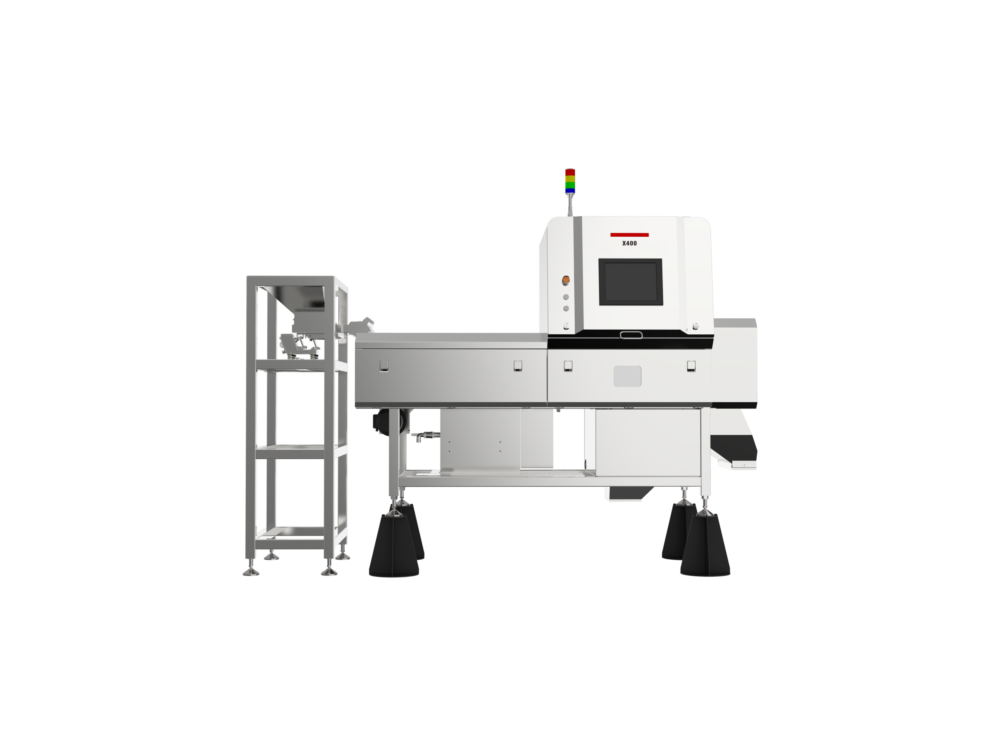
| Product Name | X-Ray Sorting Machine |
| Model | X400 |
| Capacity | 1.5-3 t/h |
| Accuracy | ≥99.9% |
| Voltage | 220V / 50Hz |
| Power | 2.5 kW |
| Weight | 800 kg |
| Dimension | 3076 × 1362 × 2466 mm |
The X400 X-Ray Sorting Machine is an intelligent multi-sensor inspection solution designed for beans, seeds, nuts, and other bulk agricultural materials. By integrating X-ray detection with visible-light imaging, the system evaluates both surface characteristics and additional structural or density-related information, giving food processors a more comprehensive approach to automated quality control.
Conventional optical sorting is effective when defects present clear external characteristics such as color variations, surface damage, or abnormal appearance. However, some quality defects or foreign materials may be difficult to distinguish from acceptable products through visible imaging alone. The X400 bridges this gap by combining X-ray and visible-light detection within one inspection platform.
For processors looking to automate inspection, improve sorting consistency, and reduce dependence on manual quality checks, the X400 provides a flexible platform that can be configured around specific raw materials, target defects, and finished-product requirements.
Agricultural raw materials naturally vary in size, color, shape, and other physical characteristics. In bulk processing lines, incoming materials may also contain foreign objects, damaged products, shell-related defects, or internal quality abnormalities that reduce the value of the finished product.
Standard camera systems primarily evaluate reflected visible light. This works well when the rejection target produces a recognizable surface difference, but it becomes more challenging when the defect is hidden internally or appears visually similar to acceptable material.
The X400 X-Ray Sorting Machine expands the inspection process by evaluating information from both X-ray and visible-light sensors.
As bulk material passes through the inspection zone, the detection system captures complementary information about the product. These signals are analyzed against defined sorting criteria so that identified rejection targets can be separated from the accepted material stream.
This multi-sensor approach allows processors to move beyond basic color sorting toward more comprehensive automated inspection, particularly when surface appearance alone does not provide enough information for a reliable sorting decision.
If you are unsure whether your target defect requires optical or X-ray inspection, PolySorter can evaluate your material and sorting requirements before machine selection.
The primary strength of the X400 lies in combining two different inspection methods within a single sorting platform.
Each technology contributes different information to the sorting decision.
High-resolution optical cameras evaluate surface-level characteristics across the visible spectrum. Image-enhancement technology helps the system recognize subtle differences in color and visible material characteristics.
Depending on the product and defect characteristics, visible imaging can be used to evaluate external differences such as discoloration, surface damage, shell-related abnormalities, or irregular appearance.
X-ray inspection provides information that is not limited to external appearance.
As X-rays pass through the material, differences in absorption can provide information about physical structure and density. This gives the sorting system an additional basis for identifying targets that may be difficult to distinguish using visible cameras alone.
The effectiveness of X-ray detection depends on factors such as material composition, density contrast, defect size, and product characteristics. For this reason, a specific internal defect or foreign material should be evaluated under actual sorting conditions rather than assumed to be detectable in every application.
By combining optical surface information with X-ray data, the system has access to a broader set of physical characteristics before making an accept-or-reject decision.
The standard X400 configuration specifically combines X-ray and visible-light detection.
This dual-technology architecture is particularly useful when a single detection method does not provide enough information to distinguish acceptable products from defined rejection targets.
Detection performance depends on the raw material, density contrast, target size, defect characteristics, and selected sensor configuration.
Rather than assuming that every defect can be identified automatically, the X400 should be configured around specific inspection targets. Representative sample testing can then be used to determine whether those differences can be detected and separated reliably.
X-ray inspection is particularly relevant when foreign materials create a detectable physical or density difference compared with the surrounding product.
Depending on the material and application, potential inspection targets may include:
Detectability can vary significantly according to the composition, size, position, and density of the foreign object. Sample testing is therefore recommended when a particular contaminant is critical to the application.
Some agricultural quality problems occur beneath the surface while the exterior remains relatively normal.
Depending on the product, defect characteristics, and X-ray configuration, potential inspection targets may include:
Internal inspection is especially relevant in applications where an outer shell or surface prevents conventional visible cameras from obtaining sufficient information about product condition.
The X400 series includes configurations intended for internal and external nut defect inspection.
Visible-light imaging complements X-ray inspection by evaluating external product characteristics.
Depending on the material and sorting settings, potential targets may include:
Combining these two sources of information allows the sorting system to address different defect characteristics within the same processing workflow.
For a specific contaminant or internal defect, PolySorter recommends testing representative material samples to confirm detection feasibility before the final machine configuration is selected.
Acquiring imaging data is only the first step in automated sorting. The system must also interpret that information and determine whether each detected object meets the defined acceptance criteria.
For more demanding sorting challenges, the X400 platform offers configurations incorporating AI deep-learning technology.
Deep learning extracts feature differences from datasets and uses multi-layer neural networks to support target recognition. This can be valuable when natural variations in agricultural products make the distinction between acceptable and rejected material more complex than a simple color or density threshold.
The X400 platform is available with different detection configurations:
These configurations correspond to the different sensor combinations identified for the X400 series.
The tiered approach allows processors to select the level of inspection technology according to the actual sorting challenge rather than automatically choosing the most complex configuration.
The X400 platform is designed primarily for bulk agricultural and dry food materials. Include beans, seeds, peppers, and multiple varieties of nuts.
Different materials present different sorting challenges, so the appropriate detection configuration should be determined according to the product and target defect.
Typical documented applications include soybeans, mung beans, and adzuki beans.
In commercial bean-processing lines, the X400 can be incorporated into automated quality control before downstream grading, processing, or packaging.
Potential sorting objectives may include foreign-material removal, visible quality defects, and structural abnormalities where sufficient X-ray or optical contrast exists.
The documented application range also includes sunflower seeds and watermelon seeds.
Seed-processing lines typically handle continuously flowing bulk material, making stable feeding and consistent material presentation important for effective inspection.
Depending on the target, visible imaging can evaluate external quality characteristics while X-ray inspection provides additional information for structural or density-related differences.
Nut processing is one of the more demanding applications for multi-sensor inspection because important quality differences may not always be visible from the outside.
Includes walnuts, macadamias, hazelnuts, hickories, almonds, and pecans.
For applications requiring internal and external nut defect inspection, the supplied technical information specifically associates this capability with the X400 (AI+HD) configuration.
This makes the actual inspection objective particularly important during machine selection. A processor targeting internal nut-quality differences should evaluate whether the defect produces sufficient X-ray contrast and whether the HD X-ray and AI configuration is appropriate for the material.
PolySorter can evaluate representative material samples and target defects to determine whether X-ray sorting is suitable for the application.
The X400 is designed to operate as part of a continuous bulk-material processing line where stable feeding, reliable inspection, and consistent separation are important to finished-product quality.
Effective sorting begins with consistent material presentation. Product should pass through the inspection area in a controlled manner so that the X-ray and visible-light systems can obtain sufficient information for analysis.
The sorting result is also influenced by real operating conditions.
Material characteristics, incoming impurity levels, target defect size, feeding stability, grading requirements, and required finished-product quality can all affect performance. The technical documentation therefore notes that specific parameters may vary according to the environment, material, and grading conditions.
For this reason, machine selection should not be based on a single nominal capacity or accuracy figure.
The complete application should be considered: What material is being processed? What needs to be removed? Is the target visible externally? Does it produce a detectable structural or density difference? What final quality and throughput does the processing line require?
Answering these questions helps determine which inspection technology and X400 configuration best fits the application.
X-ray inspection is a non-contact detection method used in food-processing applications. During inspection, X-rays pass through the product and the detection system analyzes differences in absorption.
The inspection process itself does not make the product radioactive.
As with industrial X-ray equipment generally, installation, operation, maintenance, and radiation protection should follow the applicable equipment-safety requirements and local regulations for the market where the machine is installed.
This approach keeps food inspection and equipment safety as part of the overall system evaluation without treating safety compliance as a one-size-fits-all claim across different countries and installations.
Selecting the right X-ray sorting machine begins with defining the sorting problem, rather than simply comparing hardware specifications.
PolySorter can evaluate your raw material, target defects, expected throughput, and finished-product requirements to help identify a suitable X400 configuration.
The X400 is designed for automated inspection and sorting of bulk agricultural and food materials. Include beans, edible seeds, peppers, walnuts, macadamias, hazelnuts, hickories, almonds, and pecans.
Material passes through the inspection area where X-ray and visible-light sensors collect complementary information. The system analyzes this information according to defined sorting criteria and separates identified rejection targets from the accepted material stream.
An optical color sorter primarily evaluates visible characteristics such as color and surface appearance. X-ray inspection adds information based on how X-rays interact with the material, making it useful when relevant differences are not sufficiently visible from the surface.
Detection depends on the material, target size, physical characteristics, density contrast, and selected configuration. Potential targets can include dense foreign materials, internal structural abnormalities, and visible external defects when they create sufficient X-ray or optical contrast.
Because not every contaminant or defect responds in the same way, representative sample testing is recommended for specific detection requirements.
AI capability depends on the selected configuration. The standard X400 combines X-ray and visible-light detection. The X400 (AI) adds Dual AI Deep Learning, while the X400 (AI+HD) combines HD X-ray, visible-light detection, and Dual AI Deep Learning.
The X400 series supports multiple nut applications. For internal and external nut defect inspection, the supplied technical information specifically associates this application with the X400 (AI+HD) configuration.
The actual detectability of a particular internal defect should still be confirmed according to the nut variety, defect characteristics, and sample-testing results.
X-ray inspection does not make the inspected product radioactive. Industrial X-ray equipment should be installed and operated according to applicable equipment-safety and radiation-protection requirements in the market where it is used.
Not necessarily. Different products and defects may require different detection capabilities. Machine configuration should be selected according to the raw material, target defect, internal or external inspection requirements, processing conditions, and required finished-product quality.
Material density, defect dimensions, product characteristics, and impurity conditions can vary significantly between applications. Sample testing allows the detection response and sorting feasibility to be evaluated using representative material before the final machine configuration is confirmed.
Contact PolySorter with your raw material, target defects, and processing requirements. Our team can help evaluate the application, arrange sample testing where appropriate, and identify an X-ray sorting configuration for your production line.