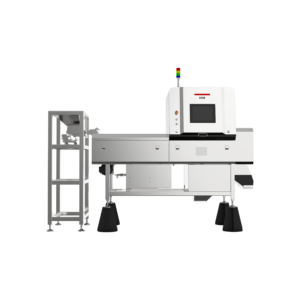
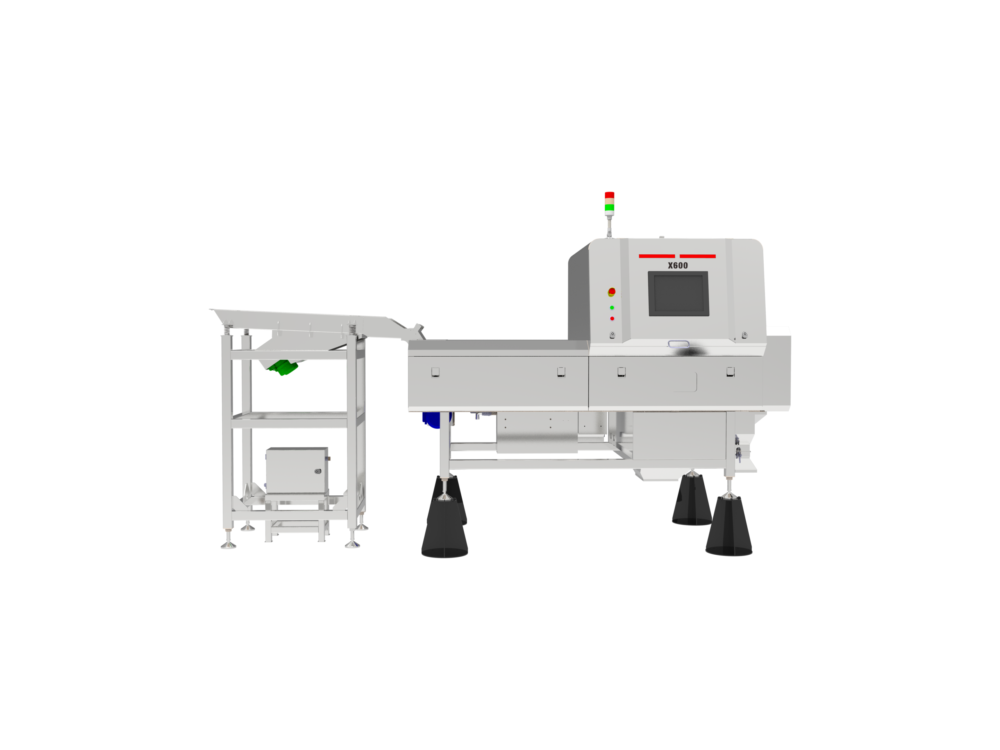
| Product Name | X-Ray Sorting Machine |
| Model | X600 |
| Capacity | 1.5-2.5 t/h |
| Accuracy | ≥99.9% |
| Voltage | 220V / 50Hz |
| Power | 3.5 kW |
| Weight | 900 kg |
| Dimension | 3803*1600*2316 mm |
The X600 X-Ray Sorting Machine is a 600 mm multi-sensor inspection platform designed for higher-throughput sorting of nuts, beans, seeds, and other bulk agricultural materials. By combining X-ray detection with visible-light imaging, the system evaluates external quality characteristics together with structural or density-related differences that conventional surface inspection alone may not reveal.
Different sorting challenges require different types of information. Visible imaging identifies recognizable surface differences, while X-ray inspection provides an additional detection layer for foreign materials and structural abnormalities that may be difficult to distinguish by appearance alone.
The X600 is available in Standard, AI, and AI+HD configurations. Processors can therefore select the detection level according to the raw material, target defects, production requirements, and complexity of the sorting task.
Bulk agricultural materials rarely arrive with completely uniform quality. Nuts, beans, and seeds naturally vary in size, shape, density, and appearance. Incoming material may also contain foreign objects, damaged products, shell abnormalities, or internal quality defects.
A conventional optical system mainly evaluates what can be seen on the product surface. This works well for many color and appearance differences, but it provides limited information when the relevant characteristic is hidden inside the product or relates to its internal structure.
The X600 expands the inspection process by combining visible-light imaging with X-ray detection.
As material passes through the inspection area, the system collects complementary imaging information and analyzes the product according to defined sorting criteria. Identified rejection targets can then be separated from the accepted material stream.
This approach makes the X600 particularly useful for processors handling multiple quality challenges within the same raw-material stream.
For processors evaluating X-ray sorting for a specific material, PolySorter can assess the product and target defects before configuration selection.
The X600 uses complementary detection technologies because different defects produce different physical characteristics.
High-resolution optical cameras evaluate characteristics visible on the material surface. Image-enhancement technology helps distinguish subtle differences in color and appearance.
Depending on the sorting application, visible imaging can identify characteristics such as discoloration, surface damage, broken products, shell abnormalities, and other external differences.
X-ray inspection adds information that cannot always be obtained from surface imaging.
As X-rays pass through the material, differences in absorption can reveal variations in density and internal structure. This provides another basis for distinguishing acceptable products from foreign materials or defective products.
For shell-covered products such as nuts, this capability becomes especially valuable because an acceptable external appearance does not always indicate uniform internal quality.
Combining visible and X-ray information gives the sorting system a broader basis for classification.
Instead of asking a single sensor to identify every defect, the X600 uses the information most relevant to the sorting target. Visible-light imaging focuses on external appearance, while X-ray detection contributes structural and density-related information.
For more complex applications, AI recognition and HD X-ray imaging can further expand the available detection capabilities.
The X600 X-Ray Sorting Machine can be configured around several categories of inspection targets.
When sufficient X-ray contrast exists between the product and contaminant, potential targets may include:
For products where quality differences occur beneath the surface, potential inspection targets may include:
This capability is particularly relevant for shell-covered products where conventional optical cameras cannot directly evaluate internal characteristics.
Visible-light imaging can complement X-ray inspection by identifying:
Actual detection capability depends on the physical difference between acceptable material and the rejection target. Representative sample testing is recommended when a specific contaminant or internal defect is critical to the application.
Not every sorting task requires the same detection configuration. The X600 platform therefore offers three technology levels, allowing processors to match the system to the complexity of the application.
| Configuration | Detection System | Best Suited For |
| X600 Standard | X-Ray + Visible Light | General bulk-material inspection |
| X600 (AI) | X-Ray + Visible Light + Dual AI Deep Learning | More complex recognition and classification |
| X600 (AI+HD) | HD X-Ray + Visible Light + Dual AI Deep Learning | Advanced internal and external inspection, especially demanding nut applications |
The Standard configuration provides combined X-ray and optical inspection for general sorting requirements.
When product characteristics vary significantly or rejection targets are more difficult to classify using conventional rules, Dual AI Deep Learning adds another level of recognition. Deep-learning algorithms can analyze multiple product features and learn more complex differences within the inspection data.
For the most demanding applications, X600 (AI+HD) adds HD X-ray imaging to the visible-light and Dual AI detection system.
This configuration is particularly relevant to advanced nut inspection, where internal and external quality characteristics may need to be evaluated within the same sorting process.
The goal is not simply to select the configuration with the most technology. The right choice is the one that matches the actual material and inspection target.
The X600 is designed primarily for bulk agricultural and dry food processing, with applications across nuts, beans, seeds, and other compatible materials.
Nut processing is one of the key applications for advanced X-ray inspection.
A shell can conceal internal quality differences that are difficult or impossible to evaluate through surface imaging alone. X-ray technology provides an additional view of structural and density-related characteristics inside the product.
Typical X600 nut applications include:
For processors dealing with demanding internal and external nut-quality inspection, the X600 (AI+HD) provides the most advanced detection configuration within the X600 platform.
HD X-ray imaging supplies additional structural information, while visible-light detection evaluates external characteristics. Dual AI Deep Learning supports recognition when acceptable products and rejection targets show more complex variations.
This combination makes the system suitable for applications where inspection must go beyond simple surface color sorting.
The X600 can also be integrated into commercial bean and pulse processing lines.
Applicable materials include soybeans, mung beans, and adzuki beans. Sorting objectives may involve foreign materials, visible quality defects, or structural differences that can be distinguished through the available detection technologies.
For larger processing lines, the X600’s wider inspection area also provides greater material-flow capability than the narrower X400 platform.
Seed applications include sunflower seeds and watermelon seeds.
Visible imaging can evaluate surface quality, while X-ray inspection adds information about physical and structural differences within the product stream.
Stable feeding and material presentation remain important in continuous processing because consistent product flow helps the inspection system capture usable information before classification and separation.
The X600 can also be evaluated for other compatible bulk agricultural materials, including peppers.
The appropriate detection method depends on what physically distinguishes the target defect from acceptable material. New or unusual applications should therefore be evaluated using representative product samples.
If your material is not listed, contact PolySorter with information about the raw material and sorting target for application evaluation.
One of the main physical differences between the X400 and X600 platforms is the inspection width.
The X600 provides a 600 mm detection width, compared with 400 mm on the X400. This wider inspection area is designed for production lines with greater material-flow requirements.
For commercial processors, however, inspection width is only one part of capacity planning.
Material type, particle or product size, feeding conditions, incoming impurity levels, sorting criteria, and required final quality can all affect real processing capacity.
For example, dense beans and lightweight seeds do not move through a sorting system in exactly the same way. Likewise, a general foreign-material removal task may have different operating requirements from a complex internal-defect inspection application.
The X600 should therefore be selected as part of the complete processing line rather than from a single nominal throughput figure.
For higher-throughput operations, the objective is to balance inspection width, detection capability, material flow, and final quality requirements without creating an unnecessary bottleneck elsewhere in the process.
Choosing an X600 starts with the sorting problem, not simply the technology level.
Identify exactly what needs to be removed and why it differs from acceptable product.
Visible color or surface differences, dense foreign materials, and hidden structural abnormalities require different types of detection information.
Use the configuration comparison above as the starting point.
General X-ray and optical inspection may not require AI, while complex classification can benefit from deep-learning recognition. Advanced internal and external inspection may require the additional imaging capability of the AI+HD configuration.
Consider material dimensions, feeding characteristics, required throughput, incoming quality, and downstream specifications.
The X600’s 600 mm inspection platform is intended for greater material-flow requirements, but the complete processing conditions should determine the final machine selection.
When a specific internal defect or contaminant determines the success of the project, testing representative raw material provides the clearest basis for machine selection.
This allows the sorting target, detection configuration, and processing requirements to be evaluated together before the final setup is confirmed.
PolySorter can evaluate your material, target defects, and production requirements to help identify an appropriate X600 configuration.
The X600 is designed for automated inspection and sorting of bulk agricultural and dry food materials. Typical applications include nuts, beans, seeds, peppers, and other compatible products.
The main physical difference is inspection width. The X400 uses a 400 mm detection platform, while the X600 uses a 600 mm platform.
Both platforms are available with Standard, AI, and AI+HD detection configurations. The wider X600 platform is designed for applications with greater material-flow requirements, while the final selection should also consider the material, target defects, and required processing capacity.
Material passes through the inspection area while X-ray and visible-light sensors collect complementary information. The system analyzes relevant characteristics according to defined sorting criteria, after which identified rejection targets are separated from the accepted product stream.
Potential targets include stones, mineral fragments, glass or ceramic fragments, metal, and other dense foreign materials where sufficient X-ray contrast exists.
Detection capability varies according to the physical properties and size of the contaminant and the surrounding product.
Yes. The X600 platform includes configurations intended for internal and external nut inspection.
The X600 (AI+HD) combines HD X-ray imaging, visible-light detection, and Dual AI Deep Learning, making it the most advanced X600 configuration for demanding nut-inspection applications.
No. AI depends on the selected configuration.
X600 Standard uses X-ray and visible-light detection. X600 (AI) adds Dual AI Deep Learning, while X600 (AI+HD) adds HD X-ray imaging together with visible-light detection and Dual AI Deep Learning.
No. X-ray inspection is most useful when a target creates a detectable structural, physical, or density difference.
Defects that differ mainly in surface color or visible appearance may be more effectively identified through visible-light inspection. This is one reason the X600 combines complementary detection technologies.
X-ray inspection is a non-contact inspection method and does not make the inspected food radioactive. Industrial X-ray equipment should be installed, operated, and maintained according to the applicable equipment-safety and radiation-protection requirements of the market where it is used.
Agricultural products and defects can vary considerably in density, shape, size, and internal structure. Testing representative material helps determine whether the target characteristics can be distinguished and which detection configuration is appropriate for the intended sorting task.
The X600 X-Ray Sorting Machine combines a wider 600 mm inspection platform with X-ray and visible-light detection for commercial food-processing applications. Optional AI and AI+HD configurations extend the platform to more complex recognition and internal inspection requirements.
From nuts and beans to seeds and other bulk agricultural materials, the right X600 configuration depends on what needs to be detected, how the material behaves during processing, and the capacity required from the production line.
Contact PolySorter with your raw material, target defects, and processing requirements. Our team can help evaluate the application, arrange sample testing where appropriate, and identify an X600 configuration for your production line.