Grain processors today face increasing pressure to produce cleaner, safer, and more consistent products while controlling operating costs. Whether supplying supermarkets, exporters, food manufacturers, seed companies, or retail brands, grain quality directly affects selling price, customer satisfaction, and regulatory compliance. Even a small percentage of discolored kernels, moldy grains, stones, or other foreign materials can reduce product value, damage a company’s reputation, and lead to rejected shipments.
This is why the grain color sorter has become one of the most important pieces of equipment in modern grain processing. Instead of relying on manual inspection or traditional mechanical screening, today’s grain color sorters use high-speed optical imaging, artificial intelligence, advanced image processing, and precision air ejection systems to inspect every individual grain as it passes through the machine. Within milliseconds, defective kernels are identified and removed, allowing only premium-quality products to continue to packaging or downstream processing.
However, choosing the right grain color sorter is not always straightforward. Different manufacturers offer different camera technologies, lighting systems, sorting algorithms, chute configurations, AI capabilities, and production capacities. Some machines excel at removing obvious color defects, while others combine visible light, near-infrared sensors, ultraviolet imaging, and artificial intelligence to detect subtle defects that conventional optical systems may miss.
This guide explains what a grain color sorter is, how it works, which materials it can process, and the key factors every buyer should evaluate before investing in a modern grain color sorting machine.
What Is a Grain Color Sorter and Why Is It Important?
A grain color sorter is an intelligent optical sorting machine that automatically separates defective grains, foreign materials, and impurities from acceptable products by analyzing their visual characteristics in real time.
Unlike traditional cleaning equipment that separates materials according to size, density, or weight, a grain color sorter evaluates the appearance of every individual kernel. High-speed cameras continuously capture images as grains travel through narrow channels. Powerful software instantly compares each kernel against predefined quality standards. If a grain differs in color, brightness, texture, or shape, precision air ejectors remove it from the product stream while good grains continue uninterrupted.
Because every grain is inspected individually instead of being evaluated as part of a bulk material flow, optical sorting delivers a level of consistency that conventional mechanical separation cannot achieve.
Modern grain color sorters can identify a wide range of defects, including:
- Yellow or discolored rice
- Moldy or insect-damaged kernels
- Immature or broken grains
- Burned or black spots
- Stones and glass fragments
- Plastic contamination
- Weed seeds
- Husk fragments and straw
- Foreign grains
- Other unwanted impurities
For grain processors, this translates into several important business benefits:
- Higher finished product purity
- Improved food safety
- Greater export compliance
- Reduced labor requirements
- Higher selling prices for premium-grade products
- Lower customer complaint rates
- More stable production quality
As food safety regulations continue to become more stringent worldwide, grain color sorting is no longer viewed as an optional upgrade. For many processing plants, it has become an essential quality-control technology that improves efficiency while protecting product value
How Does a Grain Color Sorter Work?
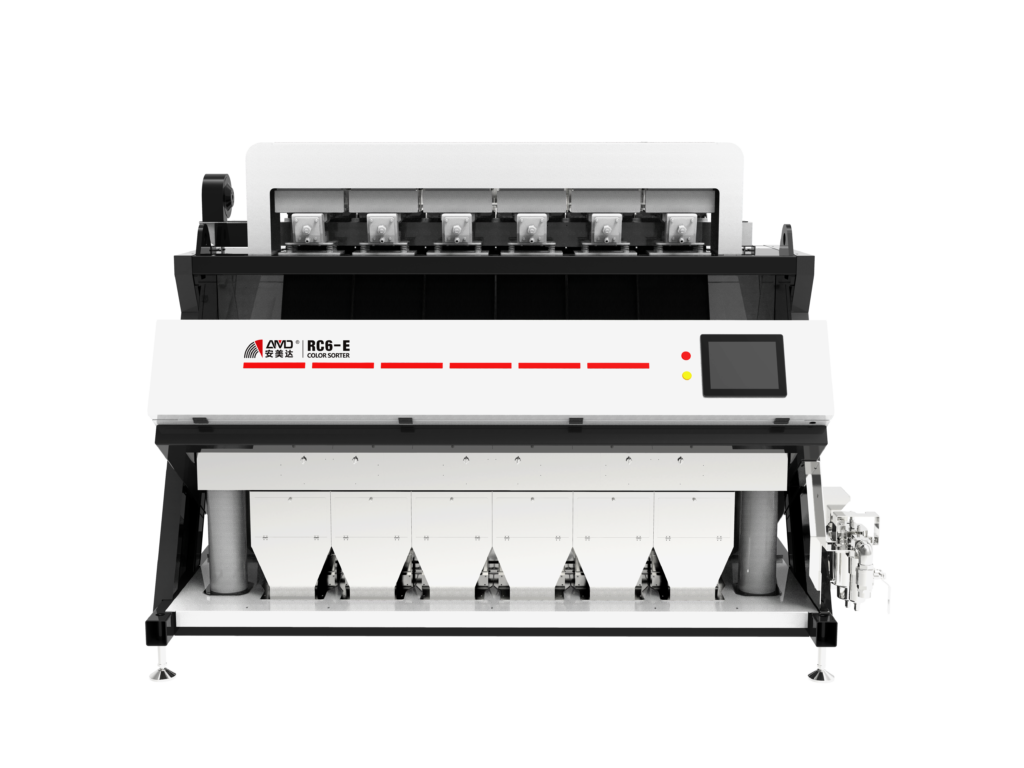
Although manufacturers use different hardware designs and proprietary software, most modern grain color sorters follow the same four-stage operating process.
1. Uniform Material Feeding
The sorting process begins with an electromagnetic vibratory feeder that distributes grains evenly across multiple chutes.
Uniform feeding is critical because overlapping kernels can reduce inspection accuracy. Modern feeding systems maintain a stable material flow even during high-capacity production, ensuring every grain remains fully visible to the inspection cameras.
2. High-Speed Optical Inspection
As grains accelerate down the chute, high-resolution cameras capture thousands of images every second.
Depending on the machine configuration, inspection systems may include:
- Full-color RGB cameras
- Ultra-HD CCD or CMOS cameras
- Near-infrared (NIR) sensors
- Ultraviolet (UV) imaging
- AI-assisted multispectral imaging
- Short-wave infrared (SWIR) sensors on selected high-end models
Each sensing technology contributes different information. RGB cameras identify visible color defects, while NIR and SWIR sensors can distinguish materials that appear similar to the human eye but have different spectral characteristics. UV imaging may detect certain contaminants, and AI-assisted vision systems analyze texture, shape, and surface features simultaneously to improve sorting accuracy.
By combining multiple sensing technologies, today’s grain color sorters achieve significantly higher detection rates than earlier generations of optical sorting equipment.
3. Intelligent Image Processing
Captured images are analyzed almost instantly by powerful onboard processors.
Rather than evaluating color alone, modern software simultaneously analyzes multiple characteristics, including:
- Color variation
- Brightness
- Shape
- Size
- Surface texture
- Edge characteristics
- Pattern recognition
Artificial intelligence has transformed this stage of the sorting process.
Instead of relying only on fixed color thresholds, AI-powered algorithms learn from large image databases and continuously optimize their recognition models for different grain varieties and quality grades.
As a result, AI systems can distinguish subtle defects more accurately while reducing false rejection of acceptable grains. This capability is particularly valuable when processing products with natural color variation or premium export-grade materials.
4. Precision Air Ejection and Yield Maximization
Once a defective grain has been identified, the control system calculates its exact position and activates a high-speed ejector valve at precisely the right moment.
The compressed air pulse lasts only a fraction of a millisecond, yet it removes the defective kernel without disturbing neighboring grains.
High-quality ejector valves are typically designed for billions of operating cycles, helping reduce maintenance requirements while maintaining reliable long-term performance.
Many advanced grain color sorters also include a re-sorting (double-sorting) system. Instead of discarding all rejected material immediately, the machine automatically sends the reject stream through a second inspection stage.
This secondary inspection recovers good grains that may have been accidentally rejected during the first pass, significantly reducing product loss while maintaining strict purity standards. For processors handling high-value grains, this feature can noticeably improve overall production yield.
Which Materials Can a Grain Color Sorter Process?
One of the greatest advantages of modern grain color sorting technology is its versatility. A single grain color sorter can often process multiple agricultural products simply by switching stored sorting recipes.
Common applications include:
- Rice (white rice, brown rice, parboiled rice)
- Wheat
- Barley
- Corn (maize)
- Oats
- Millet
- Sorghum
- Buckwheat
- Quinoa
- Sesame
- Chia seeds
- Coffee beans
- Cocoa beans
- Peanuts
- Soybeans
- Kidney beans
- Chickpeas
- Lentils
- Mung beans
- Sunflower seeds
- Pumpkin seeds
- Various spices and specialty grains
Many advanced grain color sorters also support customized sorting programs for niche crops, allowing processors to switch between products quickly while maintaining excellent sorting accuracy and high production efficiency.
Modern optical grain sorters can therefore serve a wide range of food processors, seed producers, grain exporters, and agricultural processing facilities with a single flexible platform.
How to Choose the Right Grain Color Sorter for Your Processing Plant
With dozens of grain color sorter manufacturers offering similar specifications, selecting the right machine can be challenging. While purchase price often receives the most attention, experienced processors know that long-term performance, sorting consistency, operating costs, and after-sales support have a much greater impact on profitability.
When comparing different grain color sorters, focus on the following factors instead of price alone.
Consider Your Grain Type and Production Capacity
Different agricultural products present different sorting challenges.
Rice processors typically focus on removing chalky, yellow, broken, or immature kernels. Wheat and barley processors often prioritize mold damage and foreign seeds, while bean and coffee processors require accurate recognition of products that vary significantly in size, shape, and surface texture.
Before choosing a grain color sorter, ask yourself:
- Which materials will be processed?
- Will the machine handle multiple grain varieties?
- What throughput is required per hour?
- Is future production expansion planned?
Selecting equipment with sufficient capacity not only prevents production bottlenecks but also allows your processing line to grow without replacing the machine in just a few years.
Choose Between Chute and Belt Grain Color Sorters
Most grain color sorters use vertical chutes, allowing grains to slide downward under gravity. Chute-type machines offer high throughput, compact designs, and excellent efficiency, making them ideal for products such as rice, wheat, corn, sesame, and other free-flowing grains.
However, some applications benefit from a belt-type grain color sorter.
Instead of sliding through chutes, materials travel horizontally on a conveyor belt, allowing the cameras to inspect each item while minimizing impact and movement. This design is particularly suitable for fragile, irregular, or high-value products, including large beans, peanuts, walnuts, almonds, and certain specialty seeds.
Choosing the correct platform helps improve sorting accuracy while reducing product damage.
Don’t Overlook Supporting Equipment
Many first-time buyers focus only on the grain color sorter itself and forget that the machine is part of a complete processing system.
To operate reliably, every optical grain sorter requires a stable supply of clean, dry, oil-free compressed air. Poor air quality can reduce ejection accuracy, increase maintenance, and shorten component life.
A complete installation typically includes:
- Screw air compressor
- Air storage tank
- Refrigerated or desiccant air dryer
- Precision air filters
- Dust collection system
- Bucket elevator or feeding conveyor
Planning these auxiliary systems during the purchasing stage helps avoid unexpected installation costs and ensures the sorter performs at its full potential.
Evaluate the Sensor Technology
Not all grain color sorters use the same inspection technology.
Entry-level machines generally rely on RGB cameras to identify visible color differences. While suitable for many standard applications, premium grain processing often requires more advanced detection methods.
Depending on your products and quality requirements, consider machines equipped with:
- High-resolution RGB cameras
- Ultra-HD CCD or CMOS imaging
- Near-infrared (NIR) sensors
- Short-wave infrared (SWIR) technology
- Ultraviolet (UV) imaging
- AI-powered vision systems
- Multispectral inspection
Advanced sensor combinations allow the machine to detect contaminants that cannot be distinguished by visible color alone, significantly improving sorting accuracy for premium products.
Look Beyond Sorting Accuracy
Manufacturers frequently advertise sorting accuracies exceeding 99%, but this figure alone should never determine your purchasing decision.
A high-quality grain color sorter should also provide:
- Stable performance during continuous production
- Low carryover of defective grains
- Minimal rejection of acceptable products
- Fast recipe switching
- User-friendly software
- Low compressed air consumption
- Easy cleaning and maintenance
- Reliable long-term operation
Evaluating the complete operating performance provides a much clearer picture of the machine’s true value.
Consider After-Sales Support
Even the most advanced grain color sorter requires preventive maintenance, software updates, calibration, and occasional technical assistance.
Before choosing a supplier, ask about:
- Installation and commissioning
- Operator training
- Spare parts availability
- Remote diagnostics
- Software upgrades
- Technical response time
- Warranty coverage
Strong after-sales support minimizes downtime and helps ensure stable production throughout the equipment’s service life.
Common Mistakes When Buying a Grain Color Sorter
Many processing companies invest in a grain color sorter only once every several years. As a result, purchasing mistakes can be expensive and difficult to correct later.
Some of the most common mistakes include:
Buying Based Only on Price
The lowest-priced machine is rarely the lowest-cost solution over its lifetime. Poor sorting accuracy, higher maintenance costs, increased compressed air consumption, and limited technical support often outweigh the initial savings.
Choosing Insufficient Capacity
A sorter that meets today’s production volume may become a bottleneck as your business grows. Selecting equipment with reasonable expansion capacity provides greater long-term flexibility.
Ignoring Compressed Air Quality
Even the best grain color sorter cannot perform properly if supplied with contaminated or unstable compressed air. Investing in high-quality air preparation equipment is essential for maintaining consistent sorting accuracy.
Overlooking AI and Software Performance
Hardware is only part of the system. Modern AI algorithms and image-processing software have become major factors influencing sorting precision, false rejection rates, and overall productivity.
Skipping Material Testing
Every grain behaves differently.
Before purchasing, always request a sorting test using your own material. Real production samples provide a much more accurate indication of machine performance than laboratory demonstrations or specification sheets.
Why AI Is Transforming Modern Grain Color Sorters
The latest generation of grain color sorters is moving beyond simple optical detection toward intelligent decision-making.
Traditional machines compare each grain against predefined color thresholds. While this approach works well for obvious defects, it becomes less effective when processing products with natural color variation, subtle discoloration, or complex impurity mixtures.
Artificial intelligence addresses these limitations by learning from thousands—or even millions—of grain images. Instead of relying on a single color value, AI simultaneously evaluates color, texture, contour, surface characteristics, shape, and defect patterns.
As a result, AI-powered grain color sorters can:
- Detect subtle defects with greater consistency
- Adapt to different grain varieties and harvest conditions
- Reduce false rejection of good material
- Improve sorting precision across mixed material streams
- Maintain stable performance despite changing raw material quality
For processors producing export-grade rice, certified seeds, specialty beans, or premium food ingredients, AI technology has become a major competitive advantage rather than simply an optional upgrade.
Is Investing in a Grain Color Sorter Worth It?
For most commercial grain processors, the answer is yes.
Although a grain color sorter represents a significant capital investment, its long-term economic benefits often far exceed the initial purchase cost.
A modern grain color sorter can help processors:
- Increase product purity and consistency
- Meet strict domestic and international food safety standards
- Produce higher-value premium-grade products
- Reduce manual sorting costs
- Lower customer complaints and rejected shipments
- Recover more acceptable product through intelligent re-sorting
- Improve overall production efficiency
Instead of evaluating equipment based only on purchase price, compare the total cost of ownership, including energy consumption, compressed air usage, maintenance costs, sorting performance, spare parts availability, and expected service life.
A machine that performs reliably for many years usually delivers a much higher return on investment than one purchased solely because it was less expensive.
FAQs About Grain Color Sorters
What is a grain color sorter used for?
A grain color sorter automatically removes defective grains and foreign materials by analyzing differences in color, texture, shape, and optical characteristics. It improves product purity, food safety, and overall processing efficiency.
Which grains can a grain color sorter process?
Modern grain color sorters can process rice, wheat, corn, barley, oats, millet, sorghum, beans, lentils, coffee beans, sesame, peanuts, sunflower seeds, pumpkin seeds, quinoa, buckwheat, spices, and many other agricultural products.
How accurate is a grain color sorter?
Under properly optimized operating conditions, high-quality grain color sorters typically achieve sorting accuracies above 99%. Actual performance depends on material quality, machine configuration, sensor technology, and operating parameters.
What supporting equipment does a grain color sorter require?
Most installations require a screw air compressor, air storage tank, refrigerated or desiccant air dryer, precision filters, and suitable feeding equipment such as bucket elevators or conveyors. Clean, dry compressed air is essential for achieving stable sorting performance.
How much compressed air does a grain color sorter consume?
Compressed air consumption varies depending on machine size, throughput, reject rate, and operating settings. Larger machines naturally require greater air capacity, making proper compressor sizing an important part of system design.
How often does a grain color sorter require maintenance?
Routine maintenance is generally straightforward and includes cleaning cameras and lighting systems, checking air filters, inspecting ejector valves, and performing periodic calibration. Following the manufacturer’s maintenance schedule helps ensure consistent long-term performance.
Can one machine sort different types of grains?
Yes. Most modern grain color sorters allow operators to save multiple sorting recipes, enabling quick product changes with minimal setup time.
Is AI necessary for grain color sorting?
Standard optical systems remain effective for many conventional applications. However, AI-powered grain color sorters provide significant advantages when processing premium products, complex impurities, or export-grade grains that demand the highest levels of purity.
How do I choose the best grain color sorter?
The best solution depends on your materials, production capacity, purity requirements, available space, and future expansion plans. In addition to machine specifications, evaluate sensor technology, software capability, platform design, energy efficiency, maintenance requirements, and supplier support before making your final decision.
Final Thoughts
A grain color sorter has evolved far beyond a simple machine that separates grains by color. Today, it is an intelligent quality-control system that combines high-speed optical imaging, advanced sensors, artificial intelligence, precision air ejection, and sophisticated software to help processors produce cleaner, safer, and more consistent products.
As quality standards continue to rise across global food markets, investing in the right grain color sorter can improve operational efficiency, increase product value, reduce waste, and strengthen your competitive position.
Every grain processing plant has unique materials, production capacities, and quality objectives. If you’re comparing different grain color sorters or planning a new processing line, PolySorter can provide material testing, customized equipment recommendations, and complete grain sorting solutions tailored to your specific application.
Contact our engineering team today to discuss your project or request a free material sorting test, and discover how the right grain color sorter can help maximize both product quality and long-term profitability.