Mining companies today face a difficult challenge: ore grades are declining while production costs continue rising. At the same time, mines are expected to improve sustainability, reduce energy consumption, and increase recovery rates. Traditional mineral processing systems can still achieve high recovery, but they often require enormous amounts of grinding energy, water, chemicals, and labor to process low-grade material.
This is why XRT ore sorting has become one of the fastest-growing technologies in modern mining.
XRT ore sorting, short for X-Ray Transmission ore sorting, is an advanced sensor-based separation technology used to identify and separate valuable ore from waste rock before downstream processing. Instead of relying only on surface color or manual inspection, XRT technology analyzes the internal density and atomic composition of individual rocks at high speed. The system then automatically removes unwanted material using precision air ejection systems.
Today, XRT sorting is widely used in gold, copper, lead-zinc, lithium, fluorite, phosphate, iron, tungsten, and manganese mining operations. It is especially valuable for low-grade deposits, complex ores, and large-scale pre-concentration projects where reducing waste early can dramatically improve profitability.
As mining operations become more automated and data-driven, XRT sorting is increasingly viewed not as an optional upgrade, but as a core part of intelligent mineral processing.
How XRT Ore Sorting Works in Modern Mining
The operating principle behind XRT ore sorting is relatively straightforward, but the technology itself is highly sophisticated.
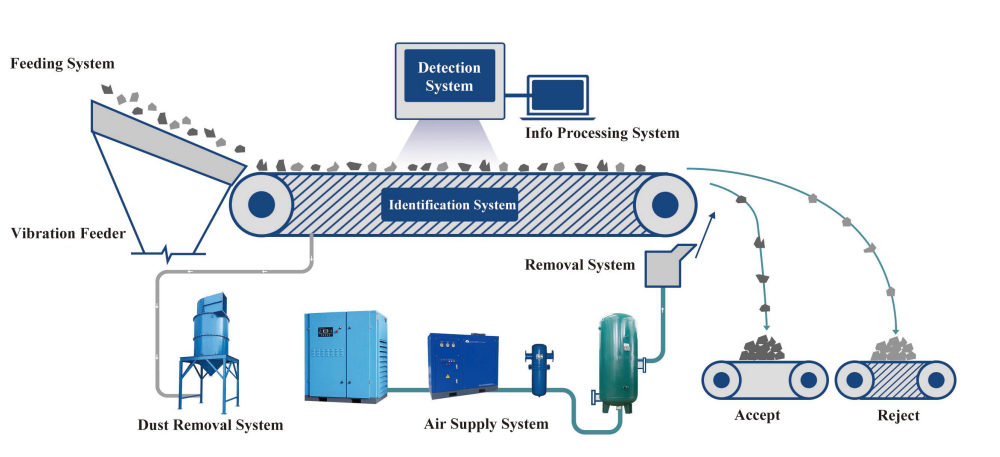
After crushing, ore particles move evenly across a high-speed conveyor belt inside the sorting machine. As the material passes through the X-ray detection zone, X-rays penetrate each particle. Different minerals absorb X-rays differently depending on their density and atomic structure.
The system instantly converts this information into grayscale imaging data. Advanced AI algorithms then analyze the material in real time to determine whether each rock should be accepted or rejected.
Once the decision is made, high-frequency pneumatic ejectors remove waste rock from the material stream within milliseconds, while valuable ore continues through the process line.
Unlike traditional optical sorters that depend mainly on visible color differences, XRT systems can identify minerals internally. This makes the technology extremely effective for ores that may look visually similar on the outside but contain completely different mineral values internally.
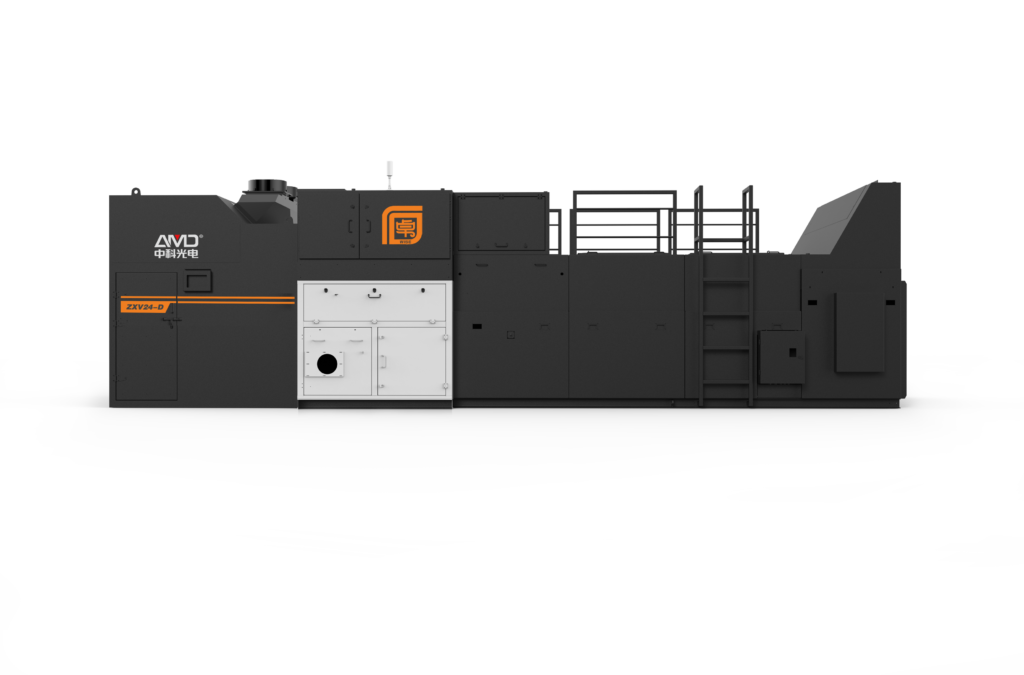
Modern XRT ore sorting systems usually include:
- X-ray transmission sensors
- AI recognition software
- High-speed conveyor systems
- Intelligent control modules
- Pneumatic air ejectors
- Real-time monitoring systems
- CCD imaging assistance
- Deep-learning ore identification algorithms
Some advanced systems also combine CCD optical recognition with XRT analysis, allowing the machine to evaluate both external color characteristics and internal density simultaneously. This hybrid approach improves sorting accuracy for complex mineral structures and mixed ores.
The result is a fast, automated, and highly accurate mineral separation process capable of operating continuously in demanding industrial environments.
Why XRT Ore Sorting Is Transforming the Mining Industry
The biggest advantage of XRT sorting is simple: it removes waste before expensive processing begins.
In conventional mineral processing, large amounts of barren rock often enter grinding mills, flotation systems, and separation circuits together with valuable ore. This increases electricity consumption, equipment wear, water usage, and reagent costs.
XRT ore sorting changes this process completely.
By rejecting low-value material early, mines can significantly reduce the volume of ore entering downstream circuits. Even a moderate reduction in waste rock can create enormous savings across the entire operation.
Lower Energy Consumption
Grinding is one of the most energy-intensive stages in mining. Reducing feed volume allows mills to process less material while maintaining metal recovery targets.
Reduced Processing Costs
Less waste entering flotation or separation circuits means lower reagent consumption, lower maintenance costs, and improved operational stability.
Improved Ore Grade
Pre-concentrated feed usually contains a higher percentage of valuable minerals, improving downstream recovery efficiency and concentrate quality.
Better Tailings Management
Removing waste earlier reduces the total volume of tailings generated by the plant, helping mining companies reduce environmental pressure and extend tailings storage capacity.
Improved Low-Grade Ore Economics
Many low-grade resources that were previously considered uneconomical can become commercially viable when XRT pre-concentration is introduced.
For mining companies operating in remote areas where water and power availability are limited, these benefits can completely change project economics.
Which Minerals Can Be Processed with XRT Ore Sorting?
One reason XRT technology has expanded so quickly is its versatility across both metallic and non-metallic minerals.
Modern XRT sorting systems are commonly used for:
- Gold ore
- Copper ore
- Lead-zinc ore
- Tungsten ore
- Lithium ore
- Iron ore
- Manganese ore
- Fluorite ore
- Phosphate ore
- Bauxite
- Molybdenum ore
- Feldspar
- Barite
Different ores require different sorting strategies depending on density contrast, mineral liberation characteristics, particle size distribution, and gangue composition.
Gold Ore Sorting
Gold mining often involves processing huge quantities of low-grade material. XRT sorting allows mines to reject barren rock during coarse or medium crushing stages before expensive grinding begins.
This can dramatically reduce operational costs while upgrading feed grade entering the plant.
Lead-Zinc Ore Sorting
Lead-zinc ores commonly contain impurities such as quartz, calcite, and pyrite. XRT systems can identify density differences between valuable minerals and waste rock, allowing mines to discard low-grade material early.
Fluorite and Phosphate Ore Sorting
Non-metallic mineral operations frequently use XRT sorting to stabilize concentrate quality and reduce flotation costs. The technology is especially effective for separating impurity minerals from usable ore.
Copper and Molybdenum Applications
Porphyry copper and molybdenum deposits can be difficult because mineralization is often finely distributed. AI-enhanced XRT systems improve recognition accuracy by combining high-resolution imaging with intelligent ore analysis algorithms.
Iron and Manganese Ore Sorting
XRT technology can also help improve concentrate grade and reduce energy consumption in iron and manganese operations by removing gangue before milling.
As AI recognition systems continue improving, XRT sorting is becoming increasingly effective for complex and mixed mineral deposits.
XRT Ore Sorting vs Traditional Mineral Processing Methods
A common misconception is that XRT ore sorting completely replaces traditional beneficiation systems.
In reality, XRT technology works best as a pre-concentration stage integrated into existing mineral processing lines.
Instead of replacing grinding, flotation, magnetic separation, or gravity separation, XRT sorting improves their efficiency by reducing the amount of waste material entering those systems.
Before Grinding
Removing barren rock before milling reduces energy consumption and improves mill productivity.
Before Flotation
Higher-grade feed entering flotation circuits often improves reagent performance and recovery stability.
During Tailings Recovery
Some mining operations use secondary XRT sorting on tailings streams to recover valuable minerals that would otherwise be lost.
For Large Particle Ore
Unlike some traditional separation methods that require fine particle liberation, XRT systems can process relatively large ore particles effectively.
Compared with manual sorting or dense media separation, XRT sorting offers several major advantages:
- Higher automation
- Continuous industrial operation
- Lower labor dependence
- Stable sorting performance
- Real-time AI analysis
- Better adaptability to complex ores
- Reduced operational costs
- Faster return on investment
Because of these advantages, many mining companies now consider sensor-based ore sorting an essential part of modern intelligent mining operations.
How to Choose the Right XRT Ore Sorting Machine
Not all XRT sorting systems are designed for the same applications. Selecting the correct equipment requires understanding both the ore characteristics and the operational goals of the mine.
Ore Type and Density Difference
The effectiveness of XRT sorting depends heavily on the density contrast between valuable minerals and waste rock.
Feed Particle Size
Different machine configurations are designed for different ore size ranges, from medium crushed particles to larger coarse ore.
Processing Capacity
Large mining operations require high-throughput sorting systems with wider detection belts and stronger air ejection systems.
Ore Moisture Content
Wet or sticky material may require special feeding systems or customized sorting chamber designs.
Sorting Objectives
Some operations prioritize waste rejection, while others focus on concentrate upgrading or tailings recovery.
Modern systems may also include advanced features such as:
- Dual-AI ore recognition
- Ultra-high-resolution XRT imaging
- Intelligent production monitoring
- High-frequency ejector valves
- AI deep-learning mineral models
- Multimodal sensing technology
For mining companies comparing suppliers, actual industrial application experience is often more important than laboratory test data alone. Field performance in gold, copper, fluorite, phosphate, or lead-zinc projects usually provides a clearer understanding of long-term reliability and sorting efficiency.
FAQ About XRT Ore Sorting
What does XRT mean in mining?
XRT stands for X-Ray Transmission. It is a sensor-based sorting technology that identifies differences in mineral density and internal composition.
What is the purpose of XRT ore sorting?
The main purpose is to remove waste rock before downstream processing, reducing operational costs and improving ore grade.
Which minerals are suitable for XRT sorting?
XRT sorting is commonly used for gold, copper, lead-zinc, lithium, phosphate, fluorite, tungsten, iron, manganese, and molybdenum ores.
Can XRT sorting improve low-grade ore profitability?
Yes. XRT pre-concentration can make low-grade deposits more economically viable by reducing grinding and flotation costs.
Is XRT sorting environmentally friendly?
Compared with traditional processing methods, XRT sorting can reduce water usage, electricity consumption, chemical usage, and tailings generation.
Does XRT ore sorting replace flotation?
No. XRT sorting is usually used before flotation or grinding as a pre-concentration stage that improves the efficiency of downstream systems.
Final Thoughts
As mining companies continue searching for ways to improve efficiency and reduce operating costs, XRT ore sorting is becoming one of the most important technologies in modern mineral processing.
By combining X-ray transmission imaging, AI recognition algorithms, intelligent controls, and high-speed ejection systems, modern XRT sorters can accurately separate valuable minerals from waste rock before expensive downstream processing begins.
The ability to reduce grinding costs, stabilize feed grade, recover value from low-grade deposits, and lower environmental impact makes XRT sorting especially attractive for both new mining projects and existing operations seeking efficiency upgrades.
For mining companies evaluating ore sorting equipment, the most important step is selecting a system that matches the ore characteristics, production targets, and long-term operational strategy of the project.
Want to see how XRT technology performs on your specific ore? [Contact Polysorter today] to request a free material sorting test and feasibility report.