Mining operations increasingly need to process lower-grade deposits while controlling waste, energy use, and downstream processing costs. One way to address this challenge is to separate identifiable waste before unnecessary material enters energy-intensive stages such as fine crushing, grinding, flotation, or leaching.
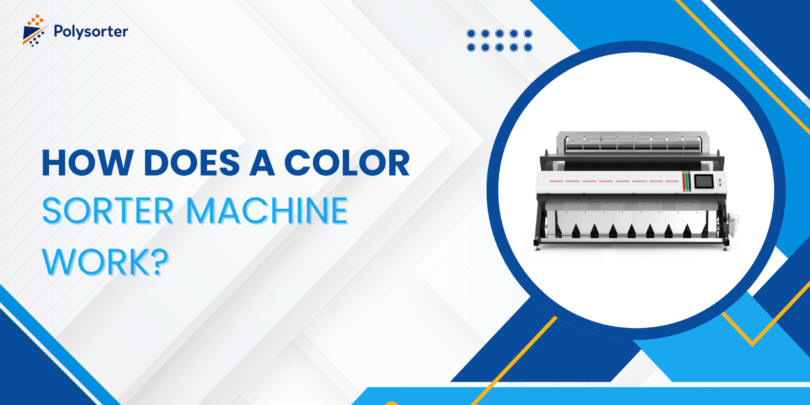
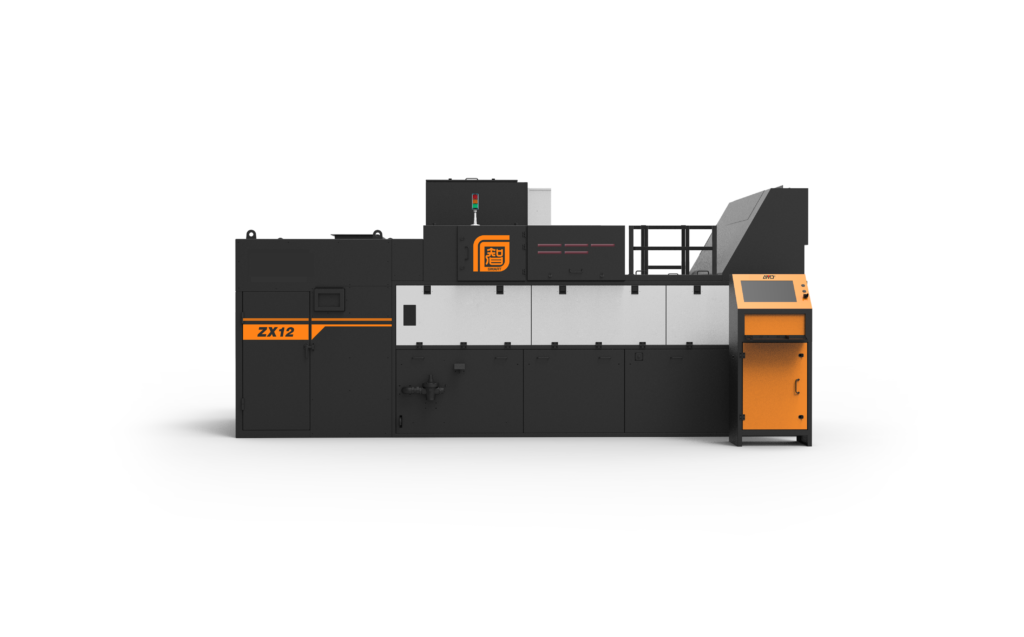
An AI ore optical sorting machine is a sensor-based sorting system that combines industrial optical imaging with artificial intelligence to identify and separate ore particles according to visible characteristics such as color, brightness, texture, shape, and surface patterns.
As material moves through the sorting zone, cameras capture images of individual particles. The recognition system analyzes these images, classifies the material, and sends instructions to a high-speed rejection system that separates selected particles into different streams.
Importantly, AI is not the sensor itself. Cameras and optical sensors collect information about the material, while AI algorithms interpret that information and determine whether a particle should be accepted or rejected.
This distinction matters when selecting ore sorting technology. AI optical sorting is most suitable when valuable minerals, gangue, impurities, or different grades show detectable surface differences. If the key distinction is primarily related to internal density or composition rather than appearance, technologies such as X-ray transmission (XRT) may be more appropriate.
For mining and mineral-processing companies considering automated pre-concentration or purification, understanding what the technology can—and cannot—detect is the first step toward choosing the right sorting system.
How Does an AI Ore Optical Sorting Machine Work?
Although an industrial ore sorter contains mechanical, optical, pneumatic, and electronic components, its basic operating process can be understood through five stages.
1. Controlled Ore Feeding
Sorting starts before the cameras inspect the material.
Crushed and classified ore must enter the machine at a controlled and reasonably uniform rate. The feeding system distributes particles so that the optical system can observe them effectively. Excessive overlap, unstable flow, or large variations in particle size can reduce recognition and ejection performance.
Screening and size classification are therefore important upstream steps in many applications.
Different ore fractions can also require different machine configurations. Fine mineral powder, small particles, medium-sized material, and large pieces of ore do not behave in the same way during feeding, detection, and rejection.
Optical sorting equipment can consequently be configured for a wide range of feed sizes. Fine-ore systems may process material in the 16–120 mesh range, while other configurations handle 1–30 mm, 2–50 mm, 3–10 cm, or even larger particles.
2. High-Resolution Optical Detection
Once material reaches the inspection zone, industrial cameras capture its visible characteristics.
Depending on the sorting objective, the optical system may evaluate:
- Color differences and discoloration
- Brightness and shade
- Surface texture
- Particle shape and contour
- Mineral veins or inclusions
- Contrasting impurities
- Combinations of multiple visual characteristics
Stable illumination is essential. Dust, shadows, changing ambient conditions, and uneven lighting can interfere with image quality. Industrial sorting systems therefore use controlled illumination and optical compensation rather than relying on ordinary visual inspection conditions.
High-resolution vision systems can capture relatively subtle surface differences while material is moving at production speed. Polysorter ore sorting systems, for example, can combine 4K imaging with multi-light-path compensation to capture material characteristics under demanding working conditions.
3. AI-Based Ore Recognition
This is where an AI-powered ore sorter differs most clearly from a basic rule-based color sorting system.
A conventional sorter may rely heavily on predefined thresholds. Material within a particular color range is accepted, while material outside that range is rejected. This approach can work well when the target and unwanted material have simple, consistent visual differences.
Natural ore is rarely that uniform.
Material from the same deposit may contain different shades, weathered surfaces, veins, stains, irregular shapes, and mixed mineral characteristics. A rigid threshold becomes less effective when the distinction between valuable material and gangue cannot be represented by a single color value.
AI-assisted recognition can evaluate combinations of characteristics. Depending on the application and system configuration, sorting logic can consider color, texture, morphology, edge characteristics, spatial information, and other visual patterns together.
Instead of asking only whether a particle is darker or lighter than a preset value, the system makes a broader classification decision:
Does this particle match the characteristics of the target material closely enough to keep it, or should it be rejected?
4. Particle Position Tracking
Recognizing an unwanted particle is only half of the sorting process.
The machine also needs to determine where that particle will be when it reaches the rejection zone.
Because ore moves through the system rapidly, the sorter has only a short time to convert image data into physical action. Particle trajectory, position, speed, posture, and edge characteristics can be used to calculate the appropriate rejection point.
Precise tracking helps prevent valuable neighboring particles from being unnecessarily removed together with the intended reject.
5. Precision Ejection
After classification and positioning, the control system sends a command to the rejection mechanism.
High-frequency valves release precisely timed compressed-air pulses to redirect selected particles. Accepted material continues along its normal path, while rejected material enters a separate stream.
Detection, classification, positioning, and ejection take place continuously as material moves through the machine.
In practical terms, the process can be summarized as:
Feed → Inspect → Recognize → Locate → Eject → Separate
This sequence forms the basis of automated optical ore sorting.
Why AI Improves Optical Ore Sorting Performance
The value of AI is not that it magically identifies every mineral. Its value lies in improving how a sorting system interprets complex visual information.
Consider a quartz-processing application. Unwanted rock may not have one uniform color, while acceptable quartz can contain natural veins, stains, or darker areas. A basic color threshold can produce incorrect decisions when these visual characteristics overlap.
AI-based image recognition provides more dimensions for classification. Instead of evaluating only whether individual pixels fall above or below a preset threshold, the system can analyze broader patterns across each particle.
This can provide several practical advantages:
- Better recognition of complex surfaces: Texture, veins, edges, spots, color distribution, and shape can collectively provide stronger classification information than color alone.
- Greater flexibility for variable feed: Ore characteristics can change between mining zones or production batches. Adjustable parameters and material recipes make it easier to adapt sorting logic to changing feed characteristics.
- More selective rejection: Recognition works together with particle positioning, helping the system target unwanted material rather than simply identifying it.
- Better control of valuable-material loss: A successful sorting process should minimize valuable ore carried into the reject fraction. Recovery, product purity, yield, and rejection performance therefore need to be considered together.
However, buyers should not interpret the word AI as a guarantee of sorting performance.
Camera quality, illumination, recognition logic, feed stability, particle presentation, ejector response, dust control, upstream preparation, and the characteristics of the ore itself all affect the final result.
AI is one part of an integrated sorting system.
For this reason, representative material testing is far more useful than selecting an AI ore optical sorting machine based only on an advertised accuracy figure.
AI Optical Ore Sorting Applications and Suitable Minerals
Optical sorting is particularly useful when the target material and unwanted material have detectable differences on their exposed surfaces.
Depending on mineral characteristics and machine configuration, potential applications include quartz, calcite, dolomite, barite, fluorite, feldspar, calcium carbonate, kaolin, and other industrial or metallic mineral streams. Optical sorting can also be used in applications involving slag, tailings, and mineral pre-concentration.
Ore pre-concentration is an important example.
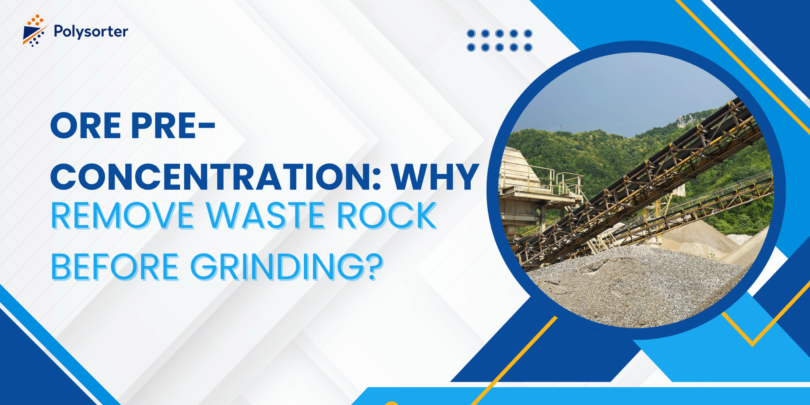
After crushing and screening, a sorter can remove identifiable barren rock before valuable material enters later processing stages. Instead of grinding both useful ore and obvious waste, the plant can send a more concentrated material stream to downstream operations.
Depending on the application, this can reduce the amount of material that needs to enter subsequent crushing, grinding, flotation, leaching, or other beneficiation processes.
Product purification is another common objective.
For industrial minerals where appearance, whiteness, discoloration, or visible contamination affects product quality, optical sorting can remove particles that do not meet the desired visual criteria. Quartz is a typical example where surface characteristics can provide useful separation information.
Particle size also matters.
Fine mineral powder behaves very differently from large rock. Specialized dry optical systems can process fine material in the 16–120 mesh range, while other sorting configurations cover small and medium particles or substantially larger ore. Systems designed for large-particle sorting can handle ranges such as 3–10 cm and 5–20 cm.
Moisture must also be considered. Fine wet particles may stick to belts or to one another, making individual particle presentation more difficult. For some machine configurations, material below 10 mm is therefore recommended for dry sorting.
These examples highlight an important purchasing principle: there is no universally ideal ore sorter for every mineral, particle size, and processing condition.
The correct technology depends on the physical characteristics that actually distinguish the target material from waste.
AI Optical Ore Sorting vs. XRT Ore Sorting
One of the biggest mistakes buyers can make is assuming that a more advanced AI optical sorter automatically replaces every other sensor technology.
It does not.
An optical sorter essentially asks:
“What does this particle look like?”
It recognizes visible characteristics such as color, texture, shape, surface structure, and brightness.
XRT asks a different question:
“How strongly does this particle attenuate X-rays?”
X-ray transmission sorting differentiates materials based on characteristics related to atomic density. It can therefore be useful when the relevant separation difference is not clearly visible on the surface.
Consider two rocks that appear almost identical to an optical camera. If their internal characteristics create a useful difference in X-ray attenuation, improving the AI image-recognition model will not solve the fundamental problem—the optical sensor is measuring the wrong characteristic.
Conversely, if valuable material and waste show strong, consistent surface differences, a more complex XRT system is not automatically necessary.
Sensor-based ore sorting can therefore use optical imaging, XRT, XRF, or combinations of different sensing approaches depending on the application.
XRT sorting systems can be applied to materials such as tungsten ore, manganese ore, phosphate ore, fluorite, molybdenum ore, copper ore, iron ore, lead-zinc ore, lithium ore, bauxite, and barite where suitable material characteristics exist.
For buyers, the question should therefore not be:
“Is AI better than XRT?”
A more useful question is:
“Which measurable difference gives us the most reliable separation between the target mineral and waste?”
Answering that question before purchasing equipment can prevent an expensive technology mismatch.
How to Choose the Right AI Ore Optical Sorting Machine
Choosing an ore sorting system should start with the material—not with a machine model or headline specification.
First, define the sorting objective. Are you trying to reject barren waste before grinding, upgrade ore grade, remove discoloration, purify an industrial mineral, recover useful material from a tailings stream, or separate two visually different mineral groups?
Next, determine whether the target difference is actually visible.
If the target mineral and waste show consistent, detectable differences in color, texture, shape, or other surface characteristics, optical sorting is a strong candidate for material testing. If the distinction mainly depends on internal density or elemental composition, another sensing technology may be necessary.
Then evaluate the feed conditions.
Particle-size distribution affects feeding, imaging, throughput, and ejection performance. A plant processing fine quartz powder has very different requirements from a mine sorting large pieces of ore. Throughput should therefore always be considered together with particle size and material characteristics rather than treated as an independent specification.
Before comparing machines, buyers should evaluate:
- Minimum and maximum feed size
- Expected throughput for the actual particle-size distribution
- Dry or wet feed conditions
- Surface cleanliness and dust levels
- Required compressed-air supply
- Feed uniformity
- Camera resolution and illumination
- AI recognition and parameter adjustment capabilities
- Rejection precision and valuable-material carryover
- Wear resistance of material-contact components
- Maintenance accessibility
- Remote diagnostics and technical support
Most importantly, test representative ore before making the final equipment decision.
Do not provide only a few hand-selected particles with obvious visual differences. A useful sorting test should represent actual production feed, including borderline particles, different grades, typical contamination, natural color variation, and a realistic particle-size distribution.
After the test, evaluate the mass balance rather than looking only at a single sorting-accuracy percentage.
A capable supplier should ultimately help determine whether AI optical recognition is appropriate for your material, what particle-size range should be processed, what feed preparation is necessary, and how the sorter should integrate into the wider mineral-processing line.
FAQ About AI Ore Optical Sorting Machines
What is an AI ore optical sorting machine?
An AI ore optical sorting machine is a sensor-based mineral sorting system that uses optical imaging to inspect ore particles and AI-assisted algorithms to classify them according to visible characteristics such as color, texture, shape, brightness, and surface patterns. A high-speed rejection system then separates selected particles.
What is the difference between an AI ore sorter and a traditional color sorter?
A traditional color sorter may rely primarily on predefined color thresholds. An AI-assisted system can evaluate combinations of visual characteristics, including texture, shape, edges, and more complex surface patterns. This can provide greater classification flexibility when natural ore shows significant visual variation.
Can AI optical sorting increase ore grade?
It can help pre-concentrate suitable material by removing identifiable waste before downstream processing. Actual grade improvement depends on mineral characteristics, liberation, feed preparation, sorting objectives, and separation performance.
Can an AI optical sorter process wet ore?
Some configurations support both dry and wet materials within specified particle-size ranges. However, moisture can cause fine particles to stick together or adhere to conveying surfaces, so the appropriate configuration should be determined according to actual feed conditions.
Is AI optical sorting better than XRT?
Neither technology is universally better. Optical sorting is appropriate when key distinguishing features are visible on the particle surface. XRT may be more suitable when materials can be differentiated through X-ray attenuation characteristics related to atomic density. Material testing should determine which sensing technology is appropriate.
What should I provide before requesting an ore sorting test?
Provide information about the mineral type, particle-size distribution, moisture condition, current grade, desired product grade, required processing capacity, and the waste or impurity you want to remove. Representative raw material samples are especially important for determining whether optical sorting can achieve the required separation.
Is an AI Ore Optical Sorting Machine Right for Your Processing Line?
An AI ore optical sorting machine can turn visible differences between mineral particles into automated, high-speed separation decisions. Its value goes beyond replacing manual sorting. In a suitable application, it can move separation earlier in the processing flow, remove identifiable waste before expensive downstream operations, and provide more consistent control over the material sent to subsequent beneficiation.
But successful ore sorting starts with choosing the right sensing technology.
AI cannot compensate for a physical difference that an optical camera cannot detect. Likewise, choosing equipment based only on maximum throughput, advertised accuracy, or the word “AI” can lead to disappointing results.
Start with the ore. Identify what separates valuable material from waste, determine the appropriate particle-size range, and validate the separation using representative samples.
Polysorter provides optical and sensor-based ore sorting solutions for different mineral characteristics, particle sizes, and processing requirements. If you are evaluating an ore sorting project, send us your material type, particle-size range, required capacity, and sorting objective. Our team can help assess the application and recommend a suitable sorting configuration for your processing line.