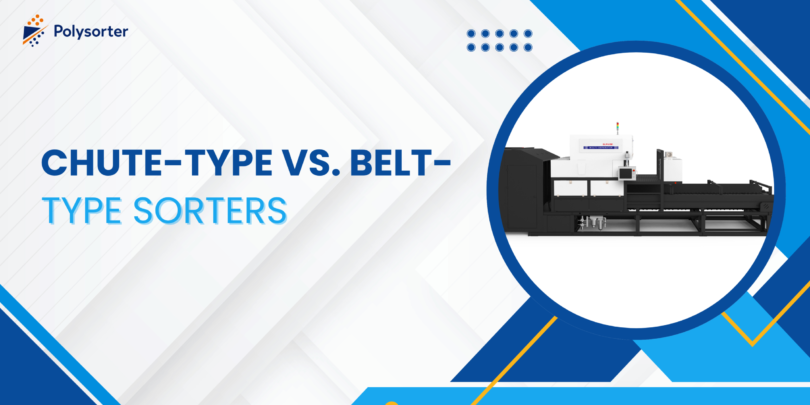
Choosing between a chute-type sorter and a belt-type sorter starts with one practical question: how does your material behave when it moves?
As a general rule, chute-type sorters are well suited to smaller, dry, free-flowing materials such as plastic flakes, pellets, and granules. Belt-type sorters are often a better choice for whole bottles, larger rigid pieces, irregular objects, or materials that need more controlled support during inspection.
But material name alone is not enough. PET pellets, washed PET flakes, irregular PET pieces, and whole PET bottles may all share the same polymer family, yet they behave very differently inside a sorting machine. Particle size, shape, moisture, surface condition, bulk density, and movement all influence how effectively the material can be presented to the sensors.
That is why the feeding system should be considered as part of the sorting process rather than simply as a machine design choice.
For recycling plants and material processors comparing different optical sorting machines, understanding this difference can help narrow down the right equipment before discussing capacity, sensor configuration, or final sorting targets.
How Chute-Type and Belt-Type Sorters Handle Material Differently
The main difference between the two systems is straightforward: a chute-type sorter relies largely on gravity to move material through the inspection area, while a belt-type sorter uses a conveyor to support and control material movement.
That difference affects how material spreads, accelerates, passes the sensors, and reaches the ejection zone.
How a Chute-Type Sorter Works
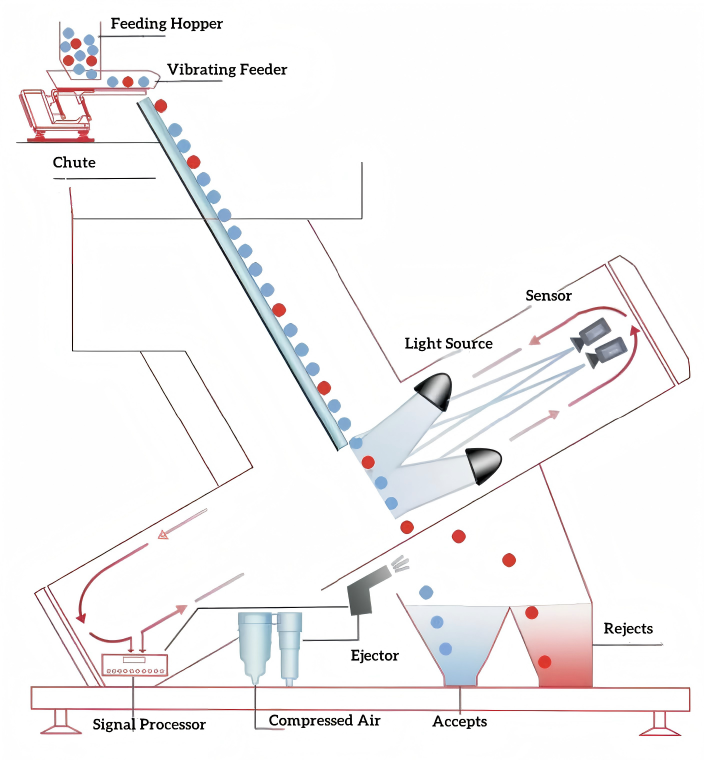
In a typical chute-type sorting system, material first enters a feeding and distribution mechanism. The feedstock is spread across the available channels and then moves down an inclined chute.
Gravity accelerates the material toward the inspection zone. Cameras or other sensors analyze the passing particles, the control system identifies the target material, and high-speed air ejectors separate selected particles from the main stream.
The process can be summarized as:
Feeding → Chute acceleration → Sensor inspection → Classification → Air ejection
This design works particularly well when individual pieces can move smoothly and predictably. Common examples include:
- plastic flakes;
- plastic pellets;
- granules;
- grains and seeds;
- other relatively small, free-flowing particles.
In plastic recycling, different sorting configurations are used for flakes, polymer separation, mixed plastics, pellets, and other feedstock forms rather than treating all plastic materials as one uniform stream.
However, a chute does not automatically suit every small material. Excessive moisture, adhesion, highly irregular shapes, or large differences in particle size can disrupt material flow and presentation.
How a Belt-Type Sorter Works
A belt-type sorter transports material on a conveyor toward the inspection area.
The material is first distributed across the belt. The conveyor then moves it at a controlled speed while the detection system inspects individual objects. Once a target is identified, the separation system directs it into the appropriate output stream.
The process is generally:
Feeding → Belt spreading → Controlled transport → Sensor inspection → Ejection
Because the material remains physically supported, belt feeding is useful for objects that are more difficult to handle through gravity alone.
Typical applications can include:
- whole plastic bottles;
- large rigid plastic pieces;
- irregularly shaped objects;
- material that tends to roll or bounce;
- certain fragile materials;
- feedstock that requires controlled presentation.
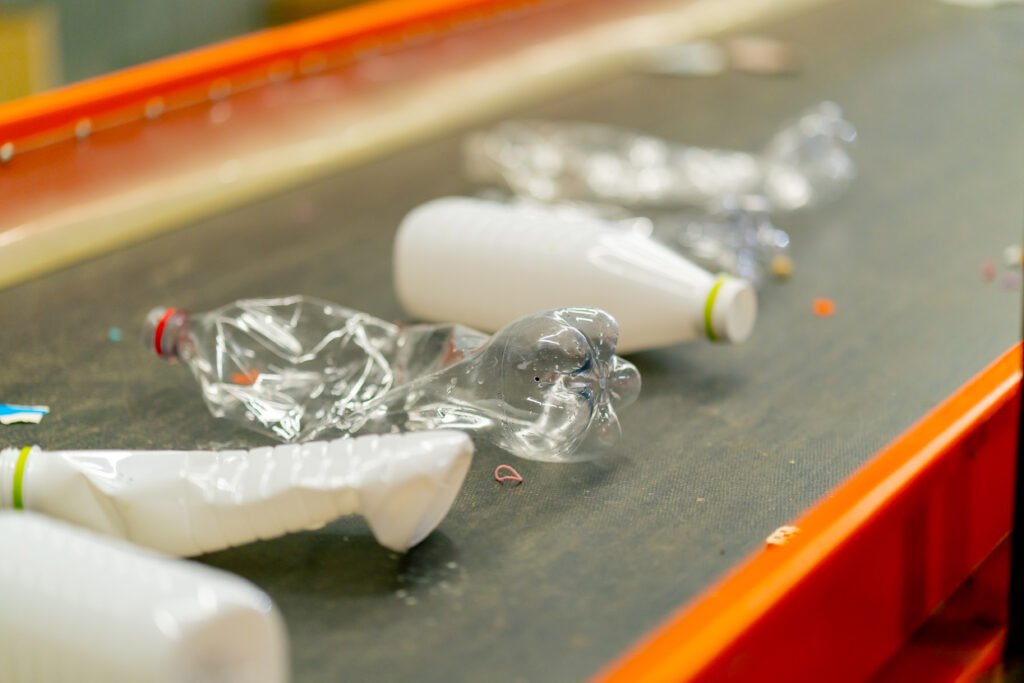
Whole bottles are a good example. Their three-dimensional shape and larger size create a completely different handling requirement from crushed flakes. Belt-oriented bottle sorting equipment therefore uses controlled transport to present these larger objects to the detection system.
Chute-Type vs. Belt-Type Sorters: Key Differences
Neither design is inherently more advanced or more accurate. The better system is the one that presents a specific feedstock more consistently under the required operating conditions.
| Selection Factor | Chute-Type Sorter | Belt-Type Sorter |
| Best suited for | Small, free-flowing material | Larger or irregular material |
| Material transport | Gravity-assisted | Conveyor-supported |
| Typical plastic feed | Flakes, pellets, granules | Bottles, rigid pieces, bulky objects |
| Shape requirement | More consistent flow preferred | Better suited to irregular shapes |
| Material support | Limited after leaving the chute | Continuous conveyor support |
| Rolling/bouncing material | Can make trajectories harder to control | Belt can provide better movement control |
| Fragile feedstock | Drop and impact should be evaluated | Often provides gentler transport |
| Wet or sticky feedstock | Often requires pretreatment for stable flow | May improve transport control, but pretreatment may still be necessary |
| Installation | Generally compact | Usually requires more floor space |
| Conveying components | Relatively simple | More mechanical conveying components |
| Best choice when… | Material naturally flows and spreads well | Material needs controlled presentation |
Throughput Should Not Be Considered Alone
Processing capacity is important, but comparing sorters only by tons per hour can be misleading.
As the feeding rate increases, the material layer can become denser. More particles may overlap, reducing the visible surface area available to cameras or other sensors. Small contaminants may also become harder to expose consistently.
The practical operating capacity therefore depends on more than how quickly a machine can transport material.
Particle size, bulk density, contamination level, feed distribution, target purity, recovery requirements, and the number of sorting passes can all affect the appropriate operating point.
Wet or Sticky Material May Need Pretreatment
A belt should not be treated as an automatic solution for poorly prepared feedstock.
Excessive moisture, dust, adhesion, or agglomeration can interfere with material presentation regardless of the feeding system. Drying, screening, cleaning, size classification, or other upstream preparation may be necessary before optical sorting.
The objective is to give the sorter a stable and sufficiently separated material stream—not simply to move difficult feedstock from one point to another.
How to Choose the Right Feeding System for Your Material
Instead of beginning with machine specifications, evaluate how the actual feedstock behaves.
1. Is the Material Dry and Free-Flowing?
Dry material that separates readily and flows consistently is generally a good candidate for chute feeding.
Plastic flakes and pellets often fall into this category after appropriate upstream preparation.
If material sticks together, bridges during feeding, or forms unstable clusters, investigate the cause first. In some applications, a belt provides better transport control. In others, the feedstock requires additional preparation before either sorting system can perform effectively.
2. What Are the Particle Size and Shape?
Smaller materials with a reasonably controlled particle-size range are usually easier to distribute through a chute.
As objects become larger and more irregular, belt feeding becomes more attractive because the conveyor physically supports them.
For example:
Plastic flakes: Washed and appropriately prepared PET, HDPE, PP, or PE flakes can be suitable for chute-type sorting when their size and flow characteristics allow stable feeding.
Plastic pellets and granules: Their relatively regular dimensions and free-flowing behavior make them particularly compatible with gravity-fed systems. Dedicated pellet sorting equipment is designed around these material characteristics.
Whole bottles: Bottles are considerably larger and have irregular three-dimensional shapes. A belt-type sorter can provide more controlled transport and presentation.
Large rigid plastic pieces: Belt feeding is often worth considering when pieces vary significantly in size or do not slide predictably.
3. Does the Material Roll, Bounce, Overlap, or Change Direction?
Particle size alone cannot answer this question.
Rounded pieces may roll. Lightweight flakes can move differently from dense rigid pieces. Irregular objects can change orientation during transport. Excessive feed density can also cause individual pieces to overlap.
These behaviors matter because sorting requires more than successful detection. After identifying an object, the machine must separate the correct target at the right moment.
The more predictable the material movement, the easier it is to maintain consistent detection and ejection.
4. Is the Material Fragile?
Some materials can tolerate rapid acceleration and drops without difficulty. Others may chip, break, or create additional fines.
If product damage is a concern, the entire material path should be evaluated, including feed height, chute movement, conveyor transfers, and discharge.
Belt transport can offer gentler handling in suitable applications because the material remains supported for a greater portion of its journey.
The Same Polymer May Need a Different Feeding System
One of the easiest mistakes in sorter selection is choosing equipment based only on the material name.
Consider PET:
PET pellets → washed PET flakes → irregular crushed PET pieces → whole PET bottles
They may all contain PET, but their physical behavior is very different.
Pellets are small and typically flow easily. Flakes are flat and may behave predictably when their size and moisture are controlled. Large crushed pieces can vary considerably in geometry. Whole bottles are bulky, three-dimensional objects.
The appropriate feeding system can therefore change even when the polymer itself does not.
Choose according to material form and behavior—not simply the polymer name.
A Quick Chute vs. Belt Sorter Selection Checklist
A chute-type sorter is worth considering when the material:
- is relatively small;
- is dry and free-flowing;
- has a manageable particle-size distribution;
- can slide and accelerate predictably;
- does not require continuous physical support.
A belt-type sorter is worth considering when the material:
- consists of larger or irregular objects;
- needs controlled conveyor transport;
- tends to roll, bounce, or move unpredictably;
- may be sensitive to impact;
- benefits from stable support during presentation.
These are selection guidelines rather than absolute rules. When feedstock characteristics vary significantly, representative sample testing provides a much stronger basis for equipment selection.
What Else Matters When Choosing an Optical Sorter?
Choosing between a chute and belt solves only the material-handling question.
It does not determine what the sorter can actually detect.
Feeding controls how material is presented. Sensors determine what characteristics can be detected.
Visible-light imaging can identify properties such as color and visible surface differences. In appropriate applications, near-infrared (NIR) sensing can analyze spectral differences between polymer types.
Sensor-based plastic sorting systems can therefore be configured for applications ranging from PET flake color sorting to polymer separation involving PET, PE, PP, PVC, ABS, PS, and other plastics.
For example, a recycling plant may need to remove differently colored flakes from a clear PET stream. Another plant may need to separate polymers that look visually similar. Although both applications involve plastic flakes, their detection requirements are different.
In practice, start with the material form and feeding behavior. Then determine what needs to be detected, which sensor technology can identify it, and what throughput and output quality the processing line must achieve.
Common Mistakes When Comparing Chute and Belt Sorters
Several purchasing mistakes can make an otherwise capable sorting system perform below expectations.
Choosing only by maximum throughput.
Capacity matters, but stable material presentation and target separation performance matter just as much.
Selecting a machine from the material name alone.
“PET,” “mixed plastic,” or “plastic flakes” does not describe particle size, shape, moisture, contamination, or feeding behavior.
Assuming a belt sorter is automatically more accurate.
Accuracy depends on the complete sorting system and the material. A well-matched chute system may be the better solution for free-flowing particles.
Ignoring upstream preparation.
Poorly screened, excessively wet, dusty, or heavily overlapping material can reduce sorting performance before the sensors even begin their work.
Choosing the feeding system separately from the sensor configuration.
Material transport and detection technology solve different problems, but they need to work together.
Why Representative Sample Testing Matters
For straightforward applications, material specifications may provide enough information for an initial equipment recommendation.
For variable or difficult feedstock, samples are much more useful.
A representative test can help evaluate how the material spreads, whether pieces overlap, how consistently they travel through the inspection area, whether the target contamination can be detected, and what operating conditions are appropriate.
When preparing samples, make sure they represent normal production—not only the cleanest or easiest material available.
That gives both the supplier and the processor a more realistic basis for selecting the feeding and sensing configuration.
FAQ About Chute-Type and Belt-Type Sorters
What is the main difference between a chute-type and belt-type sorter?
A chute-type sorter primarily uses gravity to move material toward and through the inspection area. A belt-type sorter transports material on a conveyor, providing continuous support and more controlled movement. The right choice depends mainly on material size, shape, flow behavior, and handling requirements.
Is a chute-type sorter suitable for plastic flakes?
Yes. Chute-type sorters can be well suited to appropriately sized, dry, free-flowing plastic flakes. Feedstock preparation and particle-size distribution remain important because excessive moisture, adhesion, or overlap can interfere with stable presentation.
When should I choose a belt-type optical sorter?
Consider a belt-type system for whole bottles, larger rigid plastic pieces, irregular objects, certain fragile materials, or feedstock that benefits from controlled conveyor transport rather than gravity-fed movement.
Can chute and belt sorters both use NIR technology?
Feeding architecture and sensing technology are separate design considerations. Depending on the machine configuration and application, NIR technology can be used for polymer identification, while visible-light systems can be used for color and visible-feature sorting.
Should I send material samples before choosing a chute or belt sorter?
For variable, irregular, or complex feedstock, representative samples are highly useful. Testing can help evaluate feeding behavior, sensor response, separation performance, and suitable operating conditions before the final equipment configuration is selected.
Not Sure Whether Your Material Needs a Chute or Belt Sorter?
The right sorting machine starts with the material, not the machine model.
A free-flowing stream of plastic pellets has very different feeding requirements from washed flakes, large rigid pieces, or whole bottles. At the same time, the feeding system must work together with the appropriate sensor technology and sorting objective.
If you are evaluating a sorting system, contact the PolySorter team with information about your material form, particle-size range, surface and moisture condition, target contaminants, expected throughput, and required output quality.
For difficult or highly variable feedstock, representative samples can provide an even stronger basis for evaluating the appropriate feeding method and sensor configuration before equipment selection.