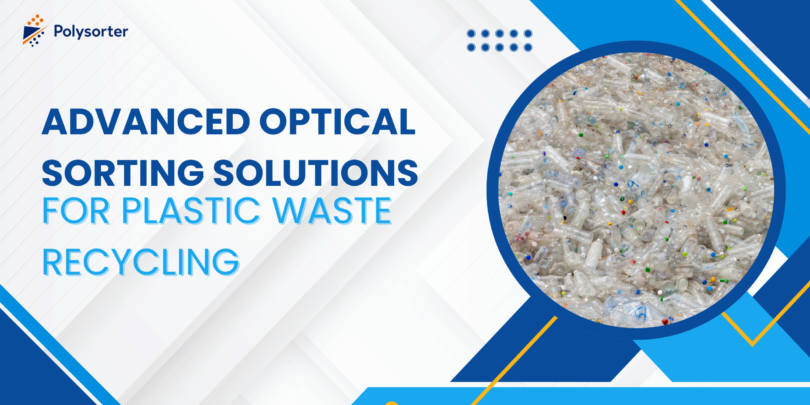
Plastic recycling may look straightforward from the outside: collect waste plastic, separate it, wash it, shred it, and turn it back into usable material. In practice, one of the hardest steps is deciding exactly what each piece of plastic is and where it should go.
PET, PE, PP, PVC, PS, ABS, and other polymers can appear surprisingly similar. Clear PET and PVC may be difficult to distinguish visually, while PP and PE pieces can share similar colors and shapes. After plastics are shredded into flakes, manual identification becomes even less practical.
So, how does the plastic sorting machine sort plastic?
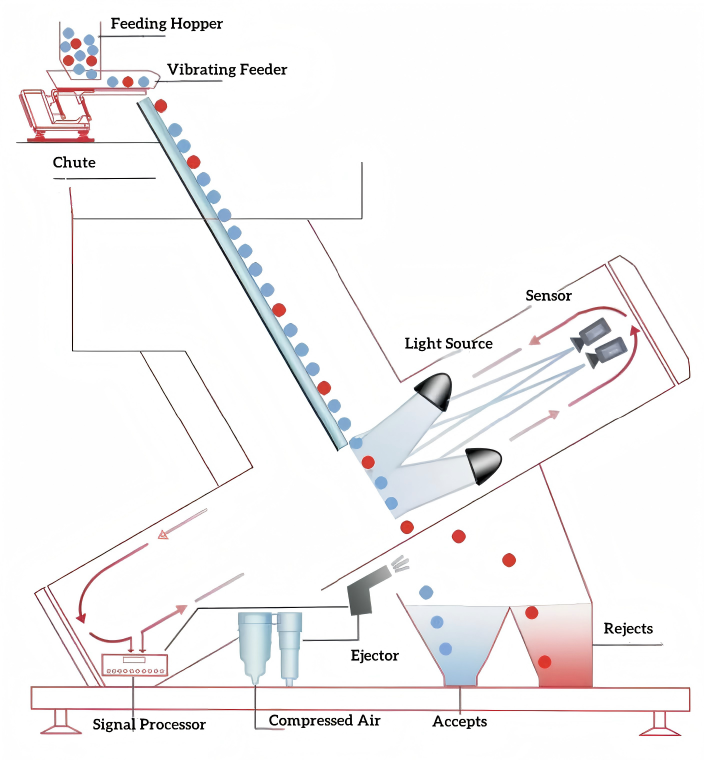
A modern plastic sorting machine uses sensors to inspect material moving through the equipment, software to classify what the sensors detect, and a high-speed separation system to send selected pieces into different output streams. Depending on the application, these machines may analyze color, shape, transparency, surface characteristics, or polymer composition.
The basic process can be summarized as:
Material Feeding → Sensor Detection → Data Analysis → Classification → Air Ejection → Separated Plastic
However, understanding this process is only the beginning. Recycling companies choosing a plastic sorter also need to understand which sensor technology matches their material, because a machine designed for PET color purification does not necessarily solve the same problem as a machine designed to separate PP from PE.
How Does a Plastic Sorting Machine Work Step by Step?
Although plastic sorting equipment comes in different configurations, most sensor-based systems follow a similar operating principle.
Step 1: Feed the Plastic in a Controlled Flow
Accurate sorting starts before the plastic reaches the sensors.
Plastic must enter the detection area in a stable and reasonably separated flow. If bottles, flakes, or plastic fragments overlap heavily, some surfaces may be hidden from the sensors. This can reduce classification accuracy regardless of how advanced the detection technology is.
The feeding method therefore depends heavily on the material:
- Belt-type systems are commonly suitable for larger or irregular materials such as bottles, containers, and larger plastic pieces. The conveyor carries the material through the detection zone while allowing the system to track individual objects.
- Chute or gravity-fed systems are more commonly used for smaller, free-flowing materials such as washed plastic flakes. The objective is the same: present enough of each particle to the sensor so that it can be identified reliably.
This is why throughput should never be considered independently from material presentation. Simply feeding more material into a sorter does not automatically mean higher useful output. If excessive loading causes overlapping pieces, effective sorting performance may actually decline.
Step 2: Scan Each Plastic Piece with Sensors
Once the material reaches the inspection zone, cameras or spectral sensors collect information about it. This is where different types of plastic sorting machines begin to behave differently.
A visible-light color sorter may analyze whether a PET flake is clear, blue, green, yellow, or another color. A NIR polymer sorter instead examines spectral information that can help determine whether the material is PET, PP, PE, PVC, ABS, PS, or another detectable polymer.
Some advanced systems combine several types of information in the same sorting process. Multi-sensor sorting can therefore answer two different questions:
What does this piece look like?
and
What type of material is it?
That distinction is extremely important when selecting plastic sorting equipment.
How Plastic Sorting Machines Identify Different Plastics
A plastic sorting machine does not identify every material using exactly the same method. Different sensors are designed to detect different characteristics.
RGB and Visible-Light Plastic Color Sorting
Visible-light cameras capture images of plastics and analyze characteristics such as color, brightness, transparency, shape, surface appearance, and visible contamination.
For example, a recycling facility processing PET flakes may want to keep clear flakes while removing blue, green, yellow, or other colored pieces. High-resolution optical cameras can identify these visible differences much faster and more consistently than manual inspection.
Color sorting is particularly useful for PET flake purification, bottle color separation, plastic pellet quality control, and the removal of visually different contaminants.
However, color does not reveal polymer chemistry.
A transparent PET fragment and a transparent PVC fragment can appear similar to a conventional color camera even though they should not remain in the same recycling stream. This is why polymer separation often requires material-sensitive detection technology.
NIR Plastic Sorting for Polymer Identification
Near-infrared, or NIR sorting, analyzes how plastic interacts with near-infrared radiation.
Different polymers have different molecular structures. When illuminated with suitable infrared wavelengths, they absorb and reflect energy differently. A NIR sensor captures these spectral differences, and the recognition system compares the resulting information with known material patterns.
Depending on the sensor configuration and material condition, this technology can distinguish many common polymers, including PET, PE, PP, PVC, PS, ABS, and various engineering plastics.
Instead of asking whether a piece is “clear or blue,” NIR sorting can help determine whether it is “PET or non-PET.” That makes the technology particularly valuable for mixed plastic recycling and polymer purification.
Quick Summary:
- RGB Sensors: Identify color, transparency, shape, and visible contaminants.
- NIR Sensors: Identify polymers through their spectral characteristics.
In applications where both polymer identity and visual quality matter, NIR information can be combined with color imaging or other sensing technologies.
AI and Intelligent Recognition Software
Sensors collect information, but they do not physically decide where each piece should go. That task belongs to the processing and classification system.
The software analyzes sensor data in real time and compares detected characteristics against the sorting recipe selected by the operator. Modern systems may use intelligent algorithms or AI-assisted recognition to analyze more complicated combinations of spectral and visual information.
AI should therefore not be viewed as a replacement for NIR or optical sensors.
- The sensor answers: “What information can we detect?”
- The recognition software answers: “What does that information mean, and what should we do with this object?”
The effectiveness of the final sorting result depends on how well the sensor, recognition algorithm, material presentation, and separation system work together.
How Does the Plastic Sorting Machine Physically Separate the Plastic?
Identifying a plastic piece is only half of the process. The machine still needs to physically separate it from the material stream.
After the recognition system classifies an object, the control system tracks its position and calculates when it will reach the separation point. A row of high-speed air valves is normally positioned near the discharge area.
When the selected piece arrives, the corresponding valve releases a short, accurately timed burst of compressed air.
That air pulse changes the trajectory of the selected material. For example:
- Target PET → Main collection stream
- PVC contaminant → Air ejector → Reject stream
Depending on the process design, the machine can also be configured for positive sorting, where the desired material is actively ejected and the remaining fraction continues along its normal trajectory.
Timing matters enormously.
The sensor, processing software, material tracking system, and ejector must work together. An inaccurate air pulse could eject neighboring good material along with the contaminant, which can reduce material recovery.
This explains why evaluating a plastic sorter only by its sensor technology can be misleading. Good sorting performance depends on the entire chain:
Stable Feeding + Reliable Detection + Accurate Classification + Precise Ejection
What Plastics Can a Plastic Sorting Machine Separate?
The answer depends on the sensors, feed material, particle size, and machine configuration.
A recycling plant processing whole bottles has very different requirements from a facility processing washed flakes or engineering plastic fragments.
PET Bottle and PET Flake Sorting
PET recycling commonly requires both polymer and color control.
A sorting line may need to remove non-PET polymers before separating clear PET from blue, green, or other colored PET. After crushing and washing, another sorting stage may be used to remove remaining polymer contamination or off-color flakes.
For recyclers targeting higher-purity PET output, evaluating both polymer contamination and color requirements before purchasing equipment can help determine whether a single-sensor or combined-sensor configuration is more suitable.
PP and PE Sorting
PP and PE are widely found in packaging, containers, automotive components, household products, and industrial plastic waste.
Because these polymers can appear visually similar, color sorting alone may not provide the material information needed for polymer separation. NIR-based identification can help distinguish suitable PP and PE fractions before downstream grinding, washing, extrusion, or pelletizing.
For mixed polyolefin recycling, buyers should therefore evaluate polymer composition rather than selecting equipment based only on visible color differences.
Engineering Plastic Sorting
Mixed engineering-plastic waste may contain ABS, PS, PC, PMMA, PA, and other polymers.
These streams can be challenging because different polymers may have similar colors and shapes. Buyers should first determine which materials must be recovered and which contaminants must be removed before selecting the appropriate sensor configuration.
Representative sample testing becomes especially useful when the incoming stream contains several engineering polymers or materials with complex surface characteristics.
Plastic Pellet and Flake Color Sorting
Not every recycling application requires polymer identification.
If the feed material is already a known polymer and the objective is mainly to remove black spots, discoloration, off-color pellets, or visually defective pieces, high-resolution optical color sorting may be the more appropriate solution.
This leads to one of the most important principles in equipment selection:
The right plastic sorting machine is not necessarily the machine with the most sensors. It is the machine whose detection technology matches the actual separation task.
How to Choose the Right Plastic Sorting Machine
Understanding how a plastic sorting machine works makes equipment selection much easier.
Before comparing models, begin with the material you actually need to process. A machine that performs well with washed PET flakes may not be the ideal configuration for whole bottles, mixed rigid plastics, engineering plastic fragments, or finished pellets.
A simple way to narrow down the technology is to identify the primary sorting objective:
- Known polymer + different colors: RGB or visible-light optical sorting may be suitable.
- Mixed PET, PP, PE, PVC, or other polymers: NIR polymer sorting should be considered.
- Polymer identification + color purification: A combined NIR and RGB configuration may provide better sorting control.
- Engineering plastics: Select the sensor system according to the specific polymers that must be recovered or rejected.
- Black or very dark plastics: Specialized detection technologies may need to be evaluated because conventional NIR can have difficulty identifying some carbon-black-containing materials.
Sensor technology is only one part of the purchasing decision.
Particle size, moisture, surface contamination, material overlap, input composition, required throughput, target purity, recovery rate, and downstream processing requirements can all influence the final configuration.
For this reason, buyers should be cautious about comparing plastic sorting machines only by camera resolution, number of sensors, or maximum stated throughput.
Representative material testing is one of the most useful steps before purchasing a plastic sorting machine.
A supplier can test actual bottles, flakes, fragments, or pellets to determine whether the target material can be recognized reliably and which sensor combination is appropriate. Testing also helps establish realistic expectations for purity, recovery, and processing capacity under the customer’s material conditions.
When discussing a sorting project with a supplier, it is useful to provide:
- Material type and composition
- Particle-size range
- Target polymer
- Main contaminants
- Material color
- Required throughput
- Desired output purity
- Photos or representative samples of the feed material
These details make equipment selection far more reliable than choosing a machine from specifications alone.
Frequently Asked Questions About Plastic Sorting Machines
How does a plastic sorting machine know what type of plastic it is?
Polymer sorting machines commonly use technologies such as NIR spectroscopy to analyze how plastics interact with infrared light. Different polymers produce different spectral responses, allowing suitable recognition systems to classify materials such as PET, PE, PP, PVC, PS, and ABS.
Can a plastic sorting machine separate plastics by color?
Yes. Optical cameras can distinguish plastics according to visible characteristics such as color, brightness, and transparency. This approach is commonly used for separating clear and colored PET flakes or removing discolored plastic pellets.
Can the same machine identify polymer type and color?
Some multi-sensor plastic sorting systems combine NIR detection with visible-light cameras. This allows the equipment to evaluate both polymer composition and visual characteristics when the application requires both types of information.
How are unwanted plastics removed after detection?
After identifying a target or contaminant, the control system tracks its position. High-speed air valves then release precisely timed compressed-air pulses to redirect selected pieces into a different collection stream.
Can a plastic sorting machine separate PET from PVC?
Suitable polymer-sorting systems can distinguish PET from PVC using material-sensitive detection such as NIR. Actual sorting performance depends on factors including sensor configuration, particle size, contamination, material presentation, and operating conditions.
Can plastic sorting machines identify black plastic?
Conventional NIR technology can have difficulty identifying some carbon-black-containing plastics because carbon black absorbs infrared radiation. Specialized sensor technologies may therefore be required when reliable black polymer identification is a major production objective.
Should I choose a color sorter or a NIR plastic sorter?
It depends on the separation target. If the primary difference is visible color, an optical color sorter may be sufficient. If visually similar polymers need to be separated, NIR polymer identification is generally more appropriate. When both polymer purity and color quality are important, a combined sensor configuration may provide better sorting control.
Find the Right Plastic Sorting Solution with PolySorter
So, how does the plastic sorting machine sort plastic?
It does much more than simply “look” at waste. A modern system controls the material flow, scans each detectable object, analyzes visual or spectral information, classifies the material, tracks its position, and activates precision ejectors to create separate product streams—all while material continues moving through the recycling line.
More importantly, there is no single sensor configuration that is ideal for every recycling application.
A PET flake processor focused on color purification, a mixed-plastic recycler separating PET from PP and PE, and an engineering-plastic processor handling ABS and PS may require very different sorting solutions.
If you are planning a new plastic recycling line or upgrading an existing sorting process, contact PolySorter with your material type, particle size, target polymer, main contaminants, required throughput, and desired output quality.
Our team can evaluate your material characteristics and sorting targets to recommend a suitable sensor and machine configuration for your recycling process.