Plastic recycling has moved far beyond simply separating plastics from general waste. Modern recycling plants often handle mixed streams containing PET, PE, PP, PVC, PS, ABS, engineering plastics, colored materials, labels, contaminants, and other unwanted components. Even after washing, crushing, or preliminary separation, these materials may still require further purification before they can become valuable recycled feedstock.
This is where advanced optical sorting solutions for plastic waste recycling play an increasingly important role. Instead of relying only on manual inspection or basic color separation, modern sorting systems can combine optical cameras, near-infrared (NIR) sensing, intelligent recognition software, and high-speed rejection systems to identify and separate materials according to different characteristics.
For recycling companies, however, choosing a sorting machine is not simply a question of finding the system with the most sensors or the highest specifications. The right solution depends on what material enters the plant, what contaminants need to be removed, what purity level the final product requires, and where the sorter will operate within the recycling line.
Understanding these factors makes it much easier to determine which sorting technology actually fits a recycling process.
Why Advanced Optical Sorting Matters in Plastic Waste Recycling
Plastic waste is difficult to sort because materials that look similar to the human eye can have completely different chemical compositions.
A clear PET flake and a clear PVC fragment, for example, may appear visually similar. Likewise, mixed rigid plastics can contain PP, PE, ABS, PS, PC, and other polymers with overlapping colors and shapes. A conventional visible-light camera can recognize many differences in color and appearance, but color information alone cannot reliably determine polymer composition.
At the same time, recycling plants face several additional challenges:
- Different plastic polymers may be mixed in the same waste stream.
- Flakes can vary significantly in size, color, and surface condition.
- Labels, caps, foreign materials, and other contaminants may remain after preprocessing.
- Recycled plastics may need to meet increasingly demanding downstream quality requirements.
- Valuable target material can be lost if the rejection process is not sufficiently precise.
- Feed composition may change from one batch or supplier to another.
This makes plastic sorting a material identification problem, not simply a color detection problem.
Modern systems therefore use different sensing technologies for different sorting tasks. Visible-light cameras can analyze color and surface characteristics, while NIR sensors can identify characteristic spectral responses associated with different polymers. More advanced configurations can combine multiple information channels and use sorting software to classify each detected object before a high-speed air-ejection system separates the target or contaminant fraction.
In practical plastic recycling applications, sorting requirements can extend from whole bottles and PET flakes to mixed polymers, engineering plastics, aged flakes, and plastic pellets. Each material stream may require a different sensor and feeding configuration depending on the sorting objective.
The important point for a recycling plant is that there is no single optical sorting technology that is ideal for every plastic waste stream. A bottle recovery facility, PET flake purification line, and engineering-plastic recycling plant may all use optical sorting, but they do not necessarily need the same detection system.
How Advanced Optical Sorting Solutions Work
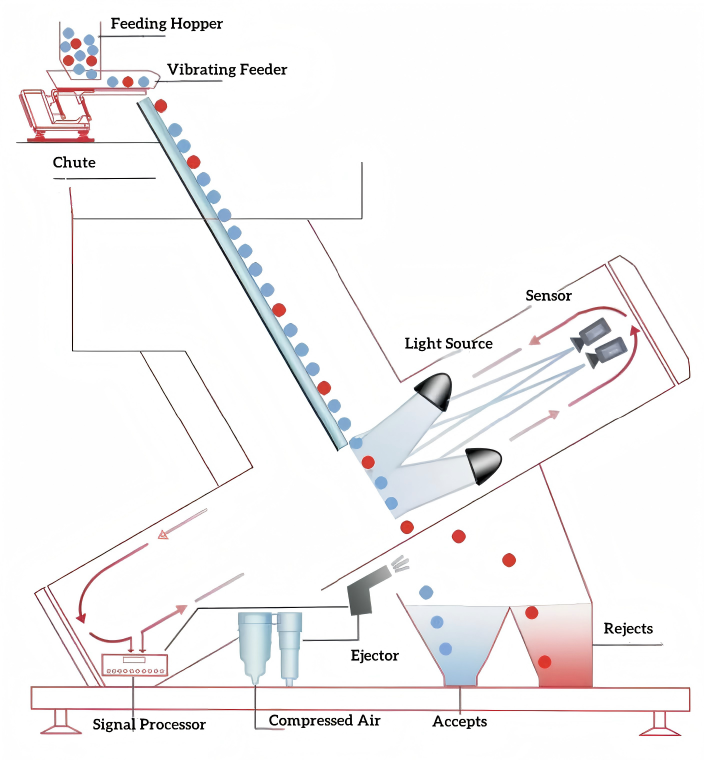
Although sensor configurations vary, most advanced plastic sorting systems follow the same basic sequence:
Material Feeding → Material Detection → Classification → Ejection → Accepted / Rejected Fractions
1. Stable Material Feeding: Chute vs. Belt Systems
Before a sensor can identify plastic accurately, the material needs to pass through the inspection area in a controlled and uniform way. Uneven feeding, excessive material depth, and unstable throughput can reduce the visibility of individual particles and make accurate classification more difficult.
Depending on the physical form of the input material, two feeding approaches are commonly used:
- Chute-Type Sorting (Gravity Fed): Commonly used for smaller, free-flowing materials such as washed plastic flakes or pellets. The material moves through the inspection area in a controlled flow, allowing individual pieces to be detected and ejected at high speed.
- Belt-Type Sorting (Conveyor Fed): Commonly applied to larger or irregular objects such as whole plastic bottles and rigid plastic pieces. A conveyor provides controlled material transport and helps the sensing system track individual objects before separation.
The correct feeding method is important because even an advanced sensor cannot classify material reliably if individual objects are poorly presented.
2. Optical and Sensor Detection
Once the material enters the inspection zone, the sensing system collects information about each detectable object.
A high-resolution RGB or visible-light camera can identify characteristics such as:
- Color
- Shape and size
- Surface appearance
- Visible defects
This makes optical color recognition particularly useful when separating clear, blue, green, or other colored plastic fractions.
When the objective is polymer identification, however, the system may use near-infrared (NIR) sensing. Different polymers interact with near-infrared radiation differently, allowing suitable sensing systems to distinguish many common plastic types based on their spectral characteristics rather than appearance alone.
For more complicated waste streams, multiple sensing methods can work together. Instead of asking only “What color is this object?”, the sorting system can evaluate several characteristics before determining where that object belongs.
3. Intelligent Material Classification
Collecting sensor data is only half of the process. The machine must also interpret that information quickly enough to make a sorting decision.
Sorting software compares detected characteristics with configured classification criteria. Depending on the application, the system may classify material according to polymer type, color, visible characteristics, or a combination of these factors.
More advanced recognition algorithms can analyze multiple object-level features, such as shape, appearance, and other recognizable characteristics. This can provide additional classification information when conventional polymer or color identification alone is not sufficient.
Intelligent recognition does not replace the sensor itself. The sensing system first needs to capture useful information about the material; software then helps convert that information into practical sorting decisions.
4. High-Speed Air Ejection
After classification, the machine tracks the position of the identified material until it reaches the separation point.
Precisely controlled air jets then eject selected objects from the material stream. Depending on how the process is configured, the machine can remove contaminants from valuable material or recover a target polymer from a mixed stream.
The quality of this stage matters because inaccurate ejection can remove good material together with contaminants. An effective sorting system therefore needs to balance purity and recovery, rather than focusing only on rejection efficiency.
Key Technologies Used in Advanced Plastic Optical Sorting
One of the easiest mistakes when selecting plastic recycling equipment is treating all optical sorters as interchangeable. In reality, different sensing technologies solve different problems.
| Sorting Technology | Main Detection Target | Typical Plastic Recycling Application |
| RGB / Visible-Light Imaging | Color and visible characteristics | Color separation of bottles, flakes, and pellets |
| NIR Sorting | Polymer characteristics | PET, PE, PP, PVC, PS, ABS, and mixed-polymer separation |
| Multi-Sensor Sorting | Multiple material characteristics | Complex mixed plastic streams and higher-purity applications |
| Intelligent Recognition | Patterns and multiple detected features | Variable or difficult-to-classify waste streams |
RGB and Visible-Light Optical Sorting
Visible-light sorting works particularly well when the difference between accepted and rejected material can be recognized visually.
For example, a recycling plant processing PET flakes may need to separate clear flakes from blue, green, or other colored flakes. Optical cameras can identify these color differences at high speed and direct unwanted pieces toward the reject stream. Visible-light technology can also help identify certain surface defects and visually different foreign materials.
Its limitation is equally important: two polymers can have nearly identical colors while having different chemical compositions. In that situation, visual information alone cannot provide enough data for reliable polymer separation.
NIR Sorting for Polymer Identification
NIR sorting addresses a different problem. Rather than depending primarily on visible color, a near-infrared sensor analyzes the spectral response of the material. This makes it possible to distinguish many common polymers that would otherwise be difficult to separate visually.
Typical applications can include separating:
- PET from non-PET plastics
- PE from other polymer fractions
- PP from mixed rigid plastics
- PVC contamination from target material
- PS and ABS in suitable engineering-plastic streams
This capability makes NIR sorting especially valuable when the recycling objective is defined by material composition rather than appearance.
However, standard NIR systems may face challenges with certain dark or carbon-black plastics because these materials can absorb much of the incident near-infrared radiation, reducing the usable spectral signal. Such applications may require specialized sensing technologies or dedicated sensor configurations, so representative material testing is particularly important.
Multi-Sensor Sorting for More Complex Waste Streams
Some recycling tasks require both polymer identification and optical classification.
Imagine a stream containing several polymer types in several colors. Identifying only the polymer may not produce the required final fraction, while identifying only the color cannot ensure polymer purity.
A multi-sensor approach can combine complementary information so that the system can make more selective decisions. This is particularly useful when recycling plants move beyond basic waste separation toward the production of higher-quality secondary raw materials.
The key question is therefore not simply:
“Which sorting technology is the most advanced?”
A more useful question is:
“Which combination of sensing technologies can reliably detect the differences that matter in my material?”
Where Advanced Optical Sorting Solutions Are Used in Plastic Recycling
The value of optical sorting becomes clearer when we look at actual recycling applications. Plastic waste can enter a recycling facility as whole bottles, crushed rigid plastics, washed flakes, engineering plastics, or pellets. Each material form creates different sorting challenges.
For this reason, the position of the sorting machine within the recycling line matters almost as much as the sensor technology itself.
Plastic Bottle Sorting
Post-consumer bottle streams often contain PET, HDPE, PP, PVC, and other materials, along with bottles of different colors.
At this stage, sorting usually focuses on recovering target bottle types while removing unwanted polymers and colors before further processing. Early separation can reduce contamination entering downstream crushing and washing equipment.
Because bottles are relatively large and irregular, belt-type feeding is commonly used to provide controlled material presentation. Depending on the input stream, a bottle sorting solution may combine polymer identification with visible-light recognition.
PET Flake Purification
After bottles have been crushed and washed, sorting requirements change.
PET flakes are much smaller than whole bottles, and contaminants may appear as individual fragments. The recycling line may need to remove non-PET polymers, unwanted colored flakes, and other detectable impurities before the material moves toward higher-value applications.
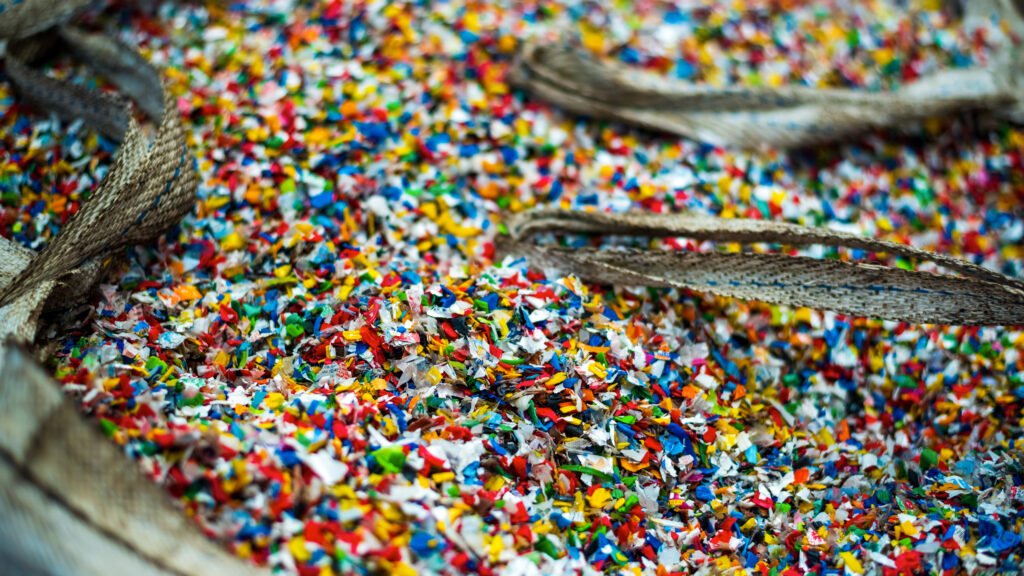
Chute-type sorting systems are commonly used for free-flowing flakes. A PET flake stream may contain:
- Clear PET flakes
- Blue or green PET flakes
- PVC fragments
- PE or PP contamination
- Other polymer fragments
- Visually defective or discolored material
The sorting objective can therefore involve more than simply identifying PET. A processor producing a clear recycled PET fraction may also need to separate unwanted PET colors after polymer contaminants have been removed.
Mixed Polymer Separation
Mixed rigid plastics create an even more complicated sorting problem.
A typical stream can contain PP, PE, PS, ABS, PC, PMMA, PET, and other materials. Some pieces may have similar colors and shapes even though their polymer compositions differ significantly.
NIR-based material recognition can help separate these plastics according to their spectral characteristics. Depending on the recycling objective, a plant may recover one target polymer at a time or use several sorting stages to create multiple valuable fractions.
Engineering Plastic Sorting
Engineering plastics can require more selective separation because the recycled material may be intended for applications where polymer consistency matters.
Streams containing ABS, PS, PC, and related materials can be difficult to separate by color alone. Suitable sensor-based systems can use polymer information together with other detected characteristics to improve classification.
This makes material testing particularly important. Buyers should confirm that the proposed sorting technology can reliably distinguish the actual materials present in their feedstock rather than assuming that a general-purpose plastic sorter will handle every engineering polymer equally well.
Plastic Pellet Sorting
Optical sorting also has applications after plastics have already been processed into pellets.
At this stage, the objective is usually different from sorting post-consumer waste. Pellet producers may need to detect discoloration, black spots, foreign particles, or other visible defects that could reduce the consistency of the final material.
High-resolution optical inspection becomes especially important because defects can be very small.
These different applications show why the term plastic sorting machine covers a broad range of equipment. A system designed for whole bottles does not automatically provide the same performance on small flakes or pellets.
How to Choose the Right Optical Sorting Solution for Your Recycling Plant
A more expensive or technically complicated sorting system is not automatically the best choice. The most effective solution is the one that matches the characteristics of the waste stream and the quality target of the recycling process.
Before comparing equipment, buyers should consider the following factors.
1. What Material Are You Processing?
Start with the input material rather than the machine.
Is the recycling line processing whole bottles, flakes, rigid plastics, engineering plastics, or pellets? Material size and form influence feeding, detection, and ejection. A belt-fed solution optimized for large rigid objects may not be suitable for small, free-flowing flakes.
2. What Purity Does the Final Product Require?
Not every recycling operation needs the same final purity.
A plant producing material for relatively tolerant downstream applications may have different requirements from a processor preparing high-quality recycled feedstock. Higher purity targets can require additional sorting stages, better preprocessing, or more selective classification.
Instead of simply asking “What is the sorting accuracy?”, it is more useful to provide information about the feed material, contamination, and required output quality. Sorting performance is always connected to the actual application.
3. What Throughput Must the System Handle?
Sorting capacity must fit the entire recycling line.
Choosing a machine with insufficient capacity can create a bottleneck. On the other hand, operating a sorter under unsuitable feeding conditions simply to maximize throughput can negatively affect material presentation and separation performance.
The goal should be stable production at the required sorting quality, rather than the highest theoretical throughput number.
Feed uniformity, particle size distribution, contamination level, and target separation can all influence practical capacity.
4. How Much Good Material Is Being Lost?
Purity is important, but so is recovery.
A sorting system could theoretically create a very clean accepted fraction by rejecting large amounts of material. If valuable target plastic is continuously sent into the reject stream, however, the recycling plant loses recoverable material and revenue.
For this reason, buyers should evaluate purity and recovery together rather than looking at purity alone. A well-configured system should remove contaminants while minimizing unnecessary loss of valuable material.
5. Where Will the Sorter Be Installed?
Optical sorting should be considered as part of the complete recycling process.
A typical process may include stages such as:
Pre-Sorting → Size Reduction → Washing → Drying → Sensor Sorting → Final Purification
The exact sequence depends on the material and recycling objective.
Installing a sophisticated sorter cannot compensate for every upstream problem. Excessive dirt, overlapping material, unstable feeding, or poor preparation can make detection more difficult. The best results usually come from designing the sorter and the surrounding process as one integrated system.
6. Test Your Material Before Final Equipment Selection
Machine specifications are useful for initial comparison, but they cannot fully predict performance on every waste stream.
Two recycling companies may both process “PET flakes” while handling very different feed materials. One stream may contain mainly colored PET, while another contains PVC, PE, labels, and multiple polymer contaminants. Particle size, moisture, surface condition, and contamination can also vary.
Representative material testing can help determine:
- Whether the target material can be reliably identified
- Which contaminants can be detected
- Which sensor configuration is appropriate
- Expected separation behavior
- Whether multiple sorting stages are necessary
- How purity and recovery interact
- Whether the proposed system matches the actual feedstock
Testing can also reduce the risk of investing in technology that does not address the plant’s main sorting problem.
For buyers comparing advanced optical sorting solutions for plastic waste recycling, sending representative samples and clearly defining the desired accepted and rejected fractions can be far more useful than comparing specification sheets alone.
FAQ About Advanced Optical Sorting for Plastic Waste Recycling
What plastics can an optical sorting machine separate?
The answer depends on the sensing technology. Visible-light systems mainly distinguish materials according to characteristics such as color and appearance, while suitable NIR-based systems can identify many common polymer types, including PET, PE, PP, PVC, PS, and ABS. Actual separation capability should always be confirmed for the specific material stream.
Can one sorting machine separate plastics by both polymer and color?
Yes, when the machine is equipped with complementary sensing technologies. The system can use polymer and color information during classification. This can be particularly useful for PET purification, where a recycler may need to remove non-PET polymers while also controlling the color composition of the final PET fraction.
Are the same optical sorters used for bottles and plastic flakes?
Not necessarily. Bottles and flakes differ significantly in physical size, material presentation, and feeding requirements. Bottle sorting commonly uses controlled belt feeding, while flake sorting can use chute-type gravity feeding. The sensing, feeding, and ejection configuration should match the physical characteristics of the material being processed.
Does AI replace NIR sensors in plastic sorting?
No. They perform different functions. Sensors collect information about the material, while intelligent algorithms help interpret detected features and make classification decisions. If polymer composition must be identified, the system still needs an appropriate sensing technology capable of capturing relevant material information.
How do I know which plastic sorting solution my recycling plant needs?
Begin by defining the input material, particle size, target polymer or contaminant, required output purity, expected throughput, and current recycling process. Representative sample testing can then help determine which sensor configuration and sorting arrangement are appropriate.
Building a More Efficient Plastic Recycling Process
Advanced optical sorting is changing plastic recycling from basic material separation into increasingly precise material recovery.
Visible-light cameras can distinguish color and surface characteristics. NIR sensing can provide polymer information. Multi-sensor configurations can combine different material characteristics, while intelligent classification software helps translate sensor data into high-speed sorting decisions.
But adding more technology is not the objective by itself. The real goal is to produce a cleaner, more valuable recycled fraction while maintaining acceptable recovery and stable throughput.
For recycling companies evaluating advanced optical sorting solutions for plastic waste recycling, the selection process should therefore begin with the waste stream: understand what enters the plant, identify what needs to be removed or recovered, define the required final quality, and then select the sensing technology around those requirements.
Planning a new plastic recycling line or upgrading an existing sorting process? Contact PolySorter and tell us your material type, particle size, major contaminants, target purity, and required throughput. Our team can help evaluate your sorting requirements and recommend a suitable sensor and machine configuration.