
Mycotoxin contamination is one of the most difficult quality-control challenges in commercial grain processing. Unlike stones, husks, broken kernels, or other obvious impurities, mycotoxins are toxic compounds produced by certain fungi. They may develop while crops are growing in the field or under unfavorable post-harvest and storage conditions.
For corn processors, aflatoxins and fumonisins are among the major concerns, while deoxynivalenol (DON), commonly associated with Fusarium infection, is particularly important in wheat processing. Corn may also be affected by DON and other fungal toxins depending on growing conditions, weather, and storage management.
The challenge is that contaminated grain is rarely distributed evenly throughout a lot. A relatively small fraction of heavily affected kernels can contribute disproportionately to the overall contamination level. At the same time, normal cleaning, milling, or downstream processing cannot be assumed to eliminate mycotoxins once they are present.
Effective mycotoxin control in corn and wheat processing therefore requires a multi-stage approach. Storage management, representative sampling, mycotoxin testing, mechanical cleaning, optical sorting, verification, and appropriate reject handling all contribute to a more reliable control strategy.
For processors evaluating a grain sorting machine, understanding where sorting fits into this system is essential. An optical sorter should not replace laboratory or validated rapid mycotoxin testing. Instead, its practical role is to identify and physically remove kernels with visible, morphological, or spectral characteristics associated with higher contamination risk before they continue downstream.
Why Mycotoxin Control in Corn and Wheat Processing Is Challenging
Effective mycotoxin management begins with an important distinction: fungal infection and toxin concentration are related, but they are not identical.
An affected kernel may show visible symptoms such as discoloration, shriveling, surface abnormalities, mold-like defects, or insect damage. These characteristics provide optical sorting equipment with useful criteria for identifying suspect material.
However, some contaminated kernels may appear relatively normal, while a visibly damaged kernel does not automatically contain a high concentration of mycotoxins. This is why sorting works best as part of a broader control program rather than as a stand-alone toxin detection method.
Two factors make the problem particularly difficult.
Heterogeneous distribution. Mycotoxin contamination can vary significantly within the same grain lot. Samples collected from different locations may therefore produce different results. Representative sampling is essential when processors need to determine whether incoming or processed grain meets the required specification.
Chemical stability. Mycotoxins are not simply surface contaminants that can always be removed by washing, aspiration, or normal milling. Once they are present, processors need to manage contaminated fractions rather than assume that later processing will neutralize them.
Different Mycotoxin Risks in Corn and Wheat
The risk profile also differs between crops.
In corn processing, aflatoxin contamination can become a serious concern when environmental and crop conditions favor fungal development. Fusarium species may also contribute to fumonisin, DON, and other mycotoxin risks. Broken kernels, insect damage, mold-related discoloration, and other abnormalities can indicate fractions that deserve greater attention during cleaning and sorting.
In wheat processing, Fusarium head blight can produce lightweight, shriveled, chalky, pale, pinkish, or otherwise abnormal kernels. These Fusarium-damaged kernels are frequently associated with elevated DON concentrations.
Because fungal damage often affects kernel appearance, structure, weight, or other measurable properties, precision cleaning and sorting can help remove higher-risk fractions before milling or further processing.
How Grain Processing and Optical Sorting Reduce Mycotoxin Risk
No single machine should carry the entire responsibility for mycotoxin management. A stronger grain processing line uses multiple control stages, with each stage targeting a different part of the problem.
Grain Conditioning and Pre-Cleaning
Mycotoxin control starts before grain reaches an optical sorter.
After harvest, appropriate drying, aeration, and storage management help limit conditions that encourage additional fungal growth. Moisture migration, condensation, insects, damaged kernels, and inadequate airflow can create localized environments where grain quality deteriorates.
When grain enters the processing line, mechanical pre-cleaning removes dust, chaff, straw, stones, broken fragments, and other foreign material. Screens and aspiration systems separate material according to size and aerodynamic characteristics, while gravity separation can remove some lightweight or poorly developed kernels.
These processes are valuable, but they have limitations. A defective kernel may have approximately the same dimensions and weight as an acceptable kernel and therefore remain in the product stream.
Precision Optical and Sensor-Based Grain Sorting
This is where an optical grain sorting machine adds another level of quality control.
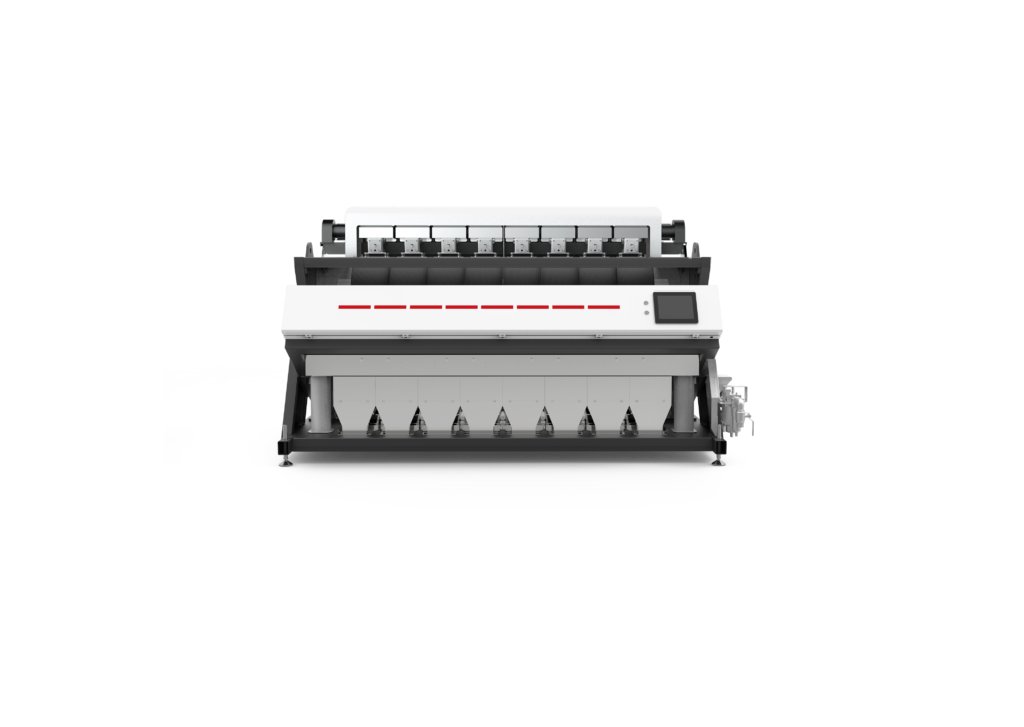
During sorting, individual kernels pass through an inspection zone where cameras and compatible sensors analyze their characteristics. Depending on the system configuration, the machine may evaluate:
- color differences and severe discoloration;
- dark spots and abnormal surface appearance;
- shriveled, broken, or malformed kernels;
- visible mold-associated defects;
- chalkiness and surface damage;
- foreign material remaining after mechanical cleaning;
- spectral differences detectable by compatible sensor technologies.
Once the system identifies a kernel that matches the configured rejection criteria, high-speed pneumatic ejectors separate it from the accepted product stream.
The key distinction is important: optical sorting does not chemically destroy mycotoxins.
Instead, it physically separates kernels identified as higher risk according to measurable characteristics. When contamination is concentrated in defective fractions, removing those fractions can help reduce the overall mycotoxin burden of the accepted grain.
Representative testing remains necessary to determine whether the processed lot meets the required food, feed, customer, or regulatory specification.
Optical Grain Sorting Technologies for Aflatoxin, Fusarium, and DON
Different grain defects require different detection strategies. A processor should therefore select sorting technology according to the actual raw material rather than simply choosing the machine with the largest number of sensors.
Visible-Light Optical Sorting
High-resolution visible-light cameras analyze characteristics that can be observed on the kernel surface.
They are particularly useful for identifying discoloration, dark blemishes, mold-like surface defects, insect damage, abnormal kernels, and other visible quality problems.
For wheat affected by Fusarium, this capability is valuable because Fusarium-damaged kernels may appear shriveled, chalky, pale, whitish, or pinkish compared with sound wheat.
In corn, visible-light sorting can help remove severely discolored, damaged, mold-affected, broken, or insect-damaged kernels when those defects are distinguishable from acceptable product.
AI-Assisted Grain Recognition
Traditional color sorting often relies heavily on differences between acceptable and defective colors. Modern image analysis can evaluate several characteristics simultaneously.
AI-assisted recognition may combine information such as:
- color;
- shape;
- surface texture;
- spot distribution;
- kernel contour;
- defect patterns.
This can improve classification when good and defective kernels overlap in basic color but differ in combinations of other visual characteristics.
It also provides greater flexibility when processors handle different grain varieties, suppliers, quality grades, or harvest conditions. Operators can adjust sorting parameters and recipes as incoming material changes.
Infrared and NIR Spectral Sorting
Near-infrared and related spectral technologies provide information beyond ordinary visible color by analyzing differences in spectral response associated with kernel composition and condition.
In suitable applications, this additional information can improve the separation of abnormal kernels that are difficult to distinguish using RGB imaging alone.
However, NIR capability should not automatically be interpreted as direct mycotoxin measurement. The practical effectiveness of any sensor configuration depends on the crop, defect characteristics, contamination pattern, calibration, and sorting objective.
For difficult applications, representative sample testing is therefore more useful than selecting a sorter solely according to a sensor specification.
Choosing a Grain Sorting Machine for Mycotoxin Control
When evaluating a grain sorting machine, sorting accuracy should never be considered in isolation.
A sorter can produce a very clean accepted fraction simply by rejecting more material. If large quantities of healthy grain leave through the reject stream, however, the resulting yield loss can make the process commercially unattractive.
The practical objective is to achieve the required grain quality while maintaining acceptable product recovery and processing capacity.
Start with the Actual Grain and Defect Profile
Machine selection should begin with representative samples.
Corn affected by insect damage, mold-like defects, broken kernels, and discoloration presents a different sorting challenge from wheat containing Fusarium-damaged kernels.
Testing actual material allows processors to determine whether visible-light sorting is sufficient or whether additional sensing technologies may provide useful separation.
Evaluate False Rejection and Product Recovery
A useful sorting trial should examine both streams:
Accepted grain: Does it achieve the required improvement in quality?
Rejected grain: Is the machine concentrating undesirable kernels into the reject stream without removing excessive amounts of healthy product?
This distinction becomes especially important in high-throughput grain plants. Even a small percentage of unnecessary good-grain rejection can represent a substantial economic loss over a full production season.
Compare Throughput Under Real Processing Conditions
Rated maximum capacity is useful for initial comparison, but it does not necessarily represent the capacity achievable for every sorting task.
Actual throughput may change according to:
- grain variety and kernel size;
- moisture and surface condition;
- contamination level;
- required sorting sensitivity;
- feed uniformity;
- acceptable reject rate;
- target finished-product quality.
A processor handling relatively clean grain may operate differently from a facility sorting a heavily contaminated incoming lot.
Check Feeding, Ejection, and Recipe Flexibility
Reliable recognition also depends on stable material presentation.
The feeding system should distribute grain consistently through the inspection zone so that individual kernels can be analyzed effectively. Once a defect is identified, responsive pneumatic ejectors must remove the target material while minimizing the rejection of neighboring good kernels.
Recipe flexibility is equally important. Grain characteristics can change between farms, regions, seasons, and suppliers. Operators should be able to save and adjust sorting parameters for different raw materials and quality targets.
For processors purchasing equipment specifically to support mycotoxin risk reduction, sample sorting followed by testing of the input, accepted, and rejected fractions provides a much stronger basis for equipment selection than visual inspection alone.
Building a Complete Mycotoxin Control Strategy
Optical sorting delivers the greatest value when integrated into a structured grain quality-control process.
A typical workflow may look like:
Incoming Grain → Sampling & Testing → Pre-Cleaning → Size/Gravity Separation → Optical Sorting → Verification Testing → Milling or Further Processing → Controlled Packaging & Storage
Each stage serves a different purpose.
Incoming sampling and testing establish the initial condition of the grain and identify lots requiring additional attention.
Mechanical cleaning removes coarse impurities, dust, lightweight material, and other contaminants that do not require precision optical recognition.
Optical sorting targets individual kernels according to visible or sensor-detectable characteristics.
Verification testing determines whether the accepted grain meets the required quality or mycotoxin specification.
Downstream processing and controlled storage help preserve the quality achieved during cleaning and sorting.
Reject management also deserves attention. Material removed during a mycotoxin-control sorting process may contain a greater concentration of damaged or higher-risk kernels than the original grain stream. Reject fractions should therefore remain segregated and be handled according to applicable food, feed, and disposal requirements rather than automatically returning to a food-grade stream.
Finally, processors should review sorting performance as incoming grain changes.
Crop variety, harvest year, growing conditions, storage history, fungal pressure, and moisture can all affect defect appearance. Periodic testing of input, accepted, and reject streams allows operators to determine whether sorting parameters continue to deliver the intended result.
This approach turns optical sorting from a simple appearance-grading step into a measurable part of a broader grain quality-control strategy.
FAQs About Mycotoxin Control
Can an optical sorting machine completely eliminate mycotoxins?
No. Optical sorters remove kernels identified as higher risk according to visible, morphological, or spectral characteristics. Because toxin concentration does not always correlate perfectly with those characteristics, sorting cannot guarantee zero mycotoxin content. Appropriate sampling and analytical testing remain necessary for verification.
How does optical sorting help reduce DON in wheat?
Fusarium infection can cause wheat kernels to become shriveled, chalky, lightweight, pale, pinkish, or otherwise abnormal. Optical sorting can identify and remove many of these Fusarium-damaged kernels, which can help reduce the DON burden entering downstream wheat processing.
Can optical sorting help with aflatoxin control in corn?
Yes, when contamination risk is concentrated in fractions that show recognizable physical or spectral abnormalities. Removing mold-damaged, discolored, broken, insect-damaged, and other higher-risk kernels can help reduce the overall aflatoxin concentration of suitable grain lots. Final testing is still necessary to verify compliance.
Is a standard color sorter enough for mycotoxin control?
It depends on the raw material and defect profile. Visible-light sorting can perform well when higher-risk kernels show recognizable color or surface abnormalities. More difficult separation tasks may benefit from additional infrared, NIR, multispectral, or AI-assisted recognition capabilities.
The appropriate configuration should be determined through representative sample testing whenever possible.
Should grain be cleaned before optical sorting?
In most processing lines, yes. Pre-cleaning removes dust, chaff, stones, large debris, and other coarse impurities before precision sorting. This improves material presentation, reduces unnecessary optical sorting workload, and helps maintain stable processing conditions.
What should I test when comparing grain sorting machines?
Do not evaluate only the appearance of the accepted grain. Compare the incoming, accepted, and rejected fractions and examine product recovery, defect removal, throughput, false rejection, feeding stability, and operating consistency.
When mycotoxin reduction is a major objective, appropriate testing of all three fractions can help determine whether higher-risk material is actually being concentrated in the reject stream.
Improve Corn and Wheat Quality with the Right Grain Sorting Strategy
Effective mycotoxin control in corn and wheat processing does not depend on a single machine. It comes from combining appropriate storage, representative sampling, mechanical cleaning, precision sorting, verification testing, and disciplined process management.
Within this system, optical sorting gives grain processors the ability to inspect and separate individual kernels at commercial production speeds. It can remove fractions associated with fungal damage, discoloration, structural defects, and other undesirable characteristics before those kernels enter milling or further processing.
The right sorting configuration depends on the grain itself. Corn and wheat varieties, contamination patterns, typical defects, throughput requirements, target quality, and acceptable product loss should all influence equipment selection.
If you are evaluating a grain sorting machine for corn or wheat processing, PolySorter can assess representative raw-material samples, typical defects, required throughput, and target product quality to help determine a suitable optical or sensor-based sorting configuration for your processing line.Contact PolySorter to discuss your corn or wheat sorting requirements and evaluate a solution based on your actual material.